What is a Wide Temperature LCD?

A wide temperature LCD is a display module engineered to function reliably far beyond the limits of standard commercial screens While your office monitor is comfortable between 0°C and 50°C, wide temperature displays are built to endure the freezing
What is a Wide Temperature LCD? The Ultimate Guide to Displays That Survive Extreme Environments
Imagine standing in a freezing warehouse at -30°C, trying to read a production monitor that has gone completely black. Or sitting in a vehicle parked under the blazing summer sun, watching your dashboard display fade into an unreadable blur. In these moments, the difference between a standard display and a wide temperature LCD becomes painfully clear.
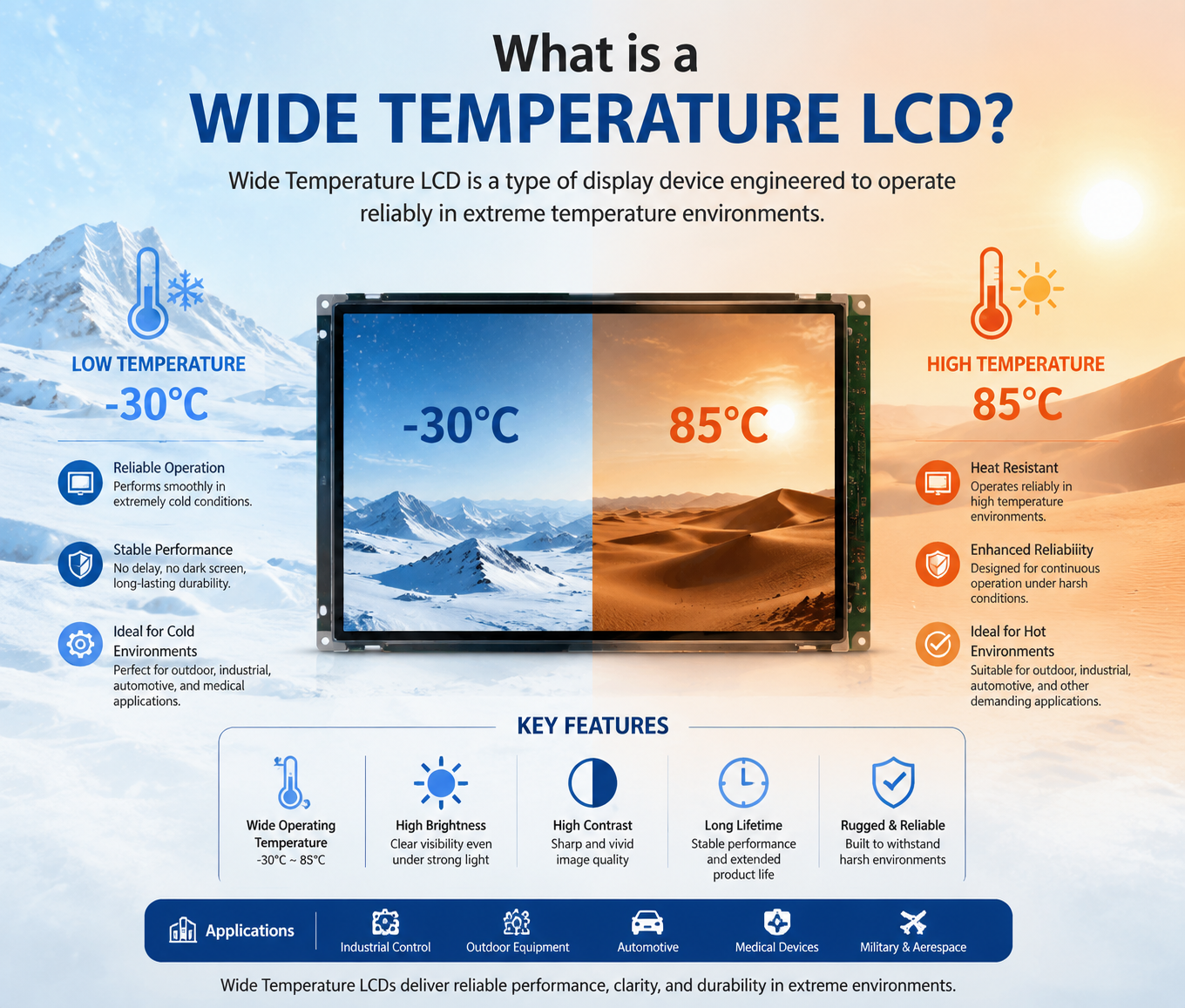
A wide temperature LCD is a display module engineered to function reliably far beyond the limits of standard commercial screens. While your office monitor is comfortable between 0°C and 50°C, wide temperature displays are built to endure the freezing cold of Arctic winters and the scorching heat of desert summers—often operating from -30°C to +85°C without missing a beat.
But what exactly makes these displays so tough? Let’s dive deep into the technology, the standards, and the applications that demand displays capable of surviving the extremes.
The Core Problem: Why Standard LCDs Fail in Extreme Temperatures
To understand why wide temperature LCDs exist, you first need to understand what happens to a standard display when temperatures go outside its comfort zone.
In extreme cold (below 0°C):
Liquid crystal molecules become sluggish and viscous
Response times slow dramatically—images lag, ghosting appears, and the screen becomes unresponsive
In severe cases, the liquid crystal material can actually freeze, causing permanent damage
In extreme heat (above 50°C):
Liquid crystals can lose their phase stability and stop functioning properly
Backlight LEDs degrade faster, reducing brightness and lifespan
Optical materials like polarizers and adhesives can warp or delaminate
The display may experience color shifting or complete blackout
Under rapid temperature changes:
Thermal expansion and contraction can cause component soldering to crack
Condensation can form inside the display when moving from cold to warm environments
Differential expansion between materials can delaminate layers
Standard commercial displays simply aren’t designed for these challenges. They’re built for climate-controlled offices, not the real world.
What Makes a Wide Temperature LCD Different?
Wide temperature LCDs achieve their remarkable resilience through a triple optimization of materials, circuitry, and structure. Here’s how each piece works:
1. Specialized Liquid Crystal Materials
The heart of any LCD is the liquid crystal material itself. Wide temperature displays use specially formulated liquid crystals with:
Lower freezing points—advanced materials can remain liquid down to -45°C or even -50°C
Higher clearing points—the temperature at which the liquid crystal becomes isotropic (loses its optical properties) is pushed well beyond 85°C
Lower viscosity at cold temperatures—reducing the sluggishness that causes slow response times in the cold
Some of the latest wide temperature liquid crystal materials can operate from -45°C all the way up to +103°C. Leading suppliers like Merck provide specialized低温液晶 (low-temperature liquid crystals) specifically for these demanding applications.
2. Industrial-Grade Driver Electronics
The driving electronics must also survive the temperature extremes:
Wide-temperature driver ICs rated for -40°C to +85°C
Temperature compensation algorithms that adjust driving signals to maintain consistent performance across the temperature range
Long-life LED backlights with high-temperature rated components
Temperature sensors that automatically adjust drive current—increasing it in the cold to compensate for brightness loss, and reducing it in the heat to protect LEDs from overheating
3. Ruggedized Construction
The physical build of a wide temperature display is equally important:
Metal housings that act as heat sinks for better thermal management
High-temperature resistant optical materials for polarizers and adhesives that won’t warp or delaminate
Reinforced soldering to prevent cracks from thermal expansion and contraction
Sealed designs with IP65 or higher ratings to keep out moisture, dust, and contaminants
Heating films or temperature control devices for extreme cold applications
Understanding the Temperature Grades
Not all wide temperature displays are created equal. The industry typically recognizes several distinct grades:
Grade | Operating Temperature | Typical Applications |
Commercial | 0°C to 50°C | Office monitors, consumer electronics, indoor retail |
Light Industrial | 0°C to 70°C | Climate-controlled factories, indoor kiosks |
Standard Industrial | -20°C to 70°C | Most factory floors, cold storage, outdoor enclosures |
Wide Temperature | -30°C to 80°C | Harsh industrial, transportation, outdoor equipment |
Ultra-Wide Temperature | -40°C to 85°C or wider | Military, aerospace, extreme environments |
Some ultra-wide temperature displays can reach even more extreme ranges, with operating temperatures from -40°C to +90°C or beyond. The latest materials have been demonstrated at -45°C to +103°C.
When evaluating a display, pay attention to both the operating temperature range (the temperatures at which the display can function) and the storage temperature range (the temperatures it can survive when powered off). Storage ranges are typically wider than operating ranges.
Reliability: How Long Will a Wide Temperature Display Last?
One of the most compelling reasons to choose a wide temperature LCD is its superior reliability. These displays are built for 7×24 continuous operation, not the 8-to-10 hour workday of a consumer monitor.
Mean Time Between Failures (MTBF) comparison:
Commercial displays: 30,000 hours or less (about 3-5 years)
Industrial wide temperature displays: 50,000 hours or more (6-8 years)
Military or high-end industrial: 80,000 to 100,000+ hours
In other words, an industrial wide temperature display typically offers 50% to 2 times the MTBF of a commercial display. This difference comes from longer-life LED backlights, industrial-grade driver ICs, wide-temperature liquid crystal materials, and more rigorous aging and screening processes.
Real-World Applications: Where Wide Temperature Displays Are Essential
Wide temperature LCDs are the unsung heroes of countless industries where standard displays simply can’t survive:
Industrial Automation and Control
Factory floors aren’t climate-controlled. From freezing cold storage facilities to foundries with furnace heat, industrial HMIs and control panels need displays that keep working no matter what.
Automotive and Transportation
Vehicle interiors experience extreme temperature swings—from sub-zero winter mornings to the oven-like heat of a car parked in summer sun. Dashboard displays, infotainment systems, and navigation screens all require wide temperature reliability.
Outdoor Equipment and Infrastructure
Outdoor kiosks, EV charging stations, vending machines, and digital signage face the full fury of the elements. Direct sunlight can push surface temperatures well above 60°C, while winter nights can drop far below freezing.
Military and Aerospace
Mission-critical systems demand absolute reliability. Wide temperature displays are found in everything from tank sighting systems to cockpit displays, often meeting stringent military standards like MIL-STD.
Marine and Navigation
Salt spray, humidity, and temperature extremes are the daily reality of marine environments. Navigation and monitoring equipment must keep working through it all.
Medical Equipment
From emergency vehicles to field hospitals, medical displays must function reliably across a wide range of environmental conditions.
Common Challenges and How Wide Temperature Displays Solve Them
Challenge | Problem | Wide Temperature Solution |
Low temperature | LCD response time slows, image ghosting | Low-viscosity liquid crystals, heating films |
High temperature | LCD blackout, backlight degradation | Heat sink designs, high-temperature materials |
Thermal shock | Solder cracks, layer delamination | Reinforced soldering, expansion-resistant design |
Condensation | Moisture ingress, short circuits | Sealed enclosures with IP65+ ratings |
Brightness loss | Dim display in cold or hot conditions | Temperature-compensated drive current |
How to Choose the Right Wide Temperature LCD
When selecting a wide temperature display for your application, consider these key factors:
1. Know Your Environment
What’s the actual temperature range your display will face? Don’t just consider average conditions—think about worst-case scenarios. Winter minimums, summer maximums, and the effects of direct sunlight on surface temperatures all matter.
2. Define Your Grade Requirements
Match the display grade to your application:
-20°C to 70°C may be sufficient for many indoor industrial applications
-30°C to 85°C provides a safety margin for most outdoor and transportation uses
-40°C to 85°C or wider is essential for military, aerospace, and extreme environments
3. Consider Brightness Needs
Many wide temperature displays are also available with high-brightness backlights (up to 1000 cd/m² or more) for sunlight readability. If your display will be used outdoors or in bright environments, this is a critical feature.
4. Verify Reliability Data
Look beyond the spec sheet. Ask about:
MTBF ratings
Specific reliability tests passed (e.g., 1000 hours at 85°C/85%RH, 1000 temperature cycles from -40°C to 85°C)
Industry certifications (MIL-STD-810, IEC 60068, etc.)
5. Plan for Long-Term Availability
Industrial equipment often has a lifecycle measured in decades. Choose displays with extended product availability to ensure replacement parts remain available throughout your product’s life.
The Bottom Line
A wide temperature LCD isn’t just a “nicer” display—it’s a fundamentally different product, engineered from the molecules up to survive conditions that would destroy a standard monitor. Yes, it costs more upfront. But when you factor in the cost of downtime, premature replacements, and the safety implications of display failure in critical systems, the investment pays for itself many times over.
Whether you’re designing an industrial control system, a vehicle display, outdoor equipment, or military hardware, choosing the right temperature grade isn’t just about specifications—it’s about ensuring your product works when and where it matters most.
Remember: The display is the window through which operators interact with your system. In extreme environments, that window needs to be built tough enough to survive whatever the world throws at it. Wide temperature LCDs are exactly that—windows to reliability, built for the real world.
Wide temperature LCDs:https://www.idtdisplay.com/products/AUO_LCD_Displays/