IPS vs TN LCD: Which Panel Is Better for Industrial Applications?

TN panels remain the cost-effective choice for basic industrial display scenarios relying on mature technology and low power consumption IPS panels have become the mainstream of mid-to-high-end industrial displays by virtue of their wide viewing angle, h
In industrial environments, display panels are far more than just output devices. They serve as the core human-machine interface (HMI) for factory automation, CNC machinery, medical equipment, smart instrumentation, and outdoor monitoring systems. Unlike consumer-grade displays that prioritize visual aesthetics alone, industrial LCDs demand stable performance, environmental adaptability, operational reliability, and long-term durability.
Among all mainstream industrial LCD technologies, TN (Twisted Nematic) and IPS (In-Plane Switching) are the two most widely used panel types. Each has unique structural characteristics, performance advantages, and scenario limitations. Many engineers and procurement teams struggle to choose between cost-effective TN panels and high-performance IPS panels for industrial projects.
This article breaks down the core technical differences, key performance metrics, industrial application scenarios, and pros and cons of IPS and TN LCDs, providing a practical selection guide for industrial display deployment.
1. Core Technical Principles: Fundamental Differences
The essential gap between TN and IPS panels lies in the arrangement and switching mode of liquid crystal molecules, which determines their inherent performance differences in viewing angle, color reproduction, and response speed.
1.1 TN (Twisted Nematic) LCD
TN is the earliest mature LCD panel technology, adopting a vertical electric field driving structure and normally white display mode. In a power-off state, liquid crystal molecules are arranged in a twisted spiral shape to allow light to pass through; when powered on, the molecules rotate vertically to block light and present a black screen.
With a simple manufacturing structure and low process difficulty, TN panels boast ultra-low production costs and high optical efficiency. The simple liquid crystal switching mechanism also enables extremely fast response speeds, which is its core technical advantage that has been maintained for decades.
1.2 IPS (In-Plane Switching) LCD
IPS is an upgraded LCD technology optimized for viewing angle and color accuracy, adopting a horizontal electric field driving structure and normally black display mode. All liquid crystal molecules are arranged parallel to the panel plane and rotate horizontally when powered on.
This unique horizontal switching design eliminates the light leakage and color shift problems common to TN panels. It achieves consistent color and brightness output from multiple viewing angles. Although the manufacturing process is more complex and power consumption is slightly higher, it brings comprehensive improvements in display quality and structural stability.
2. Key Performance Comparison for Industrial Scenarios
Industrial display evaluation focuses on practical indicators including viewing angle, color accuracy, response time, power consumption, durability, and environmental adaptability. The detailed comparison below clearly shows the performance gap between TN and IPS panels in industrial application scenarios.
2.1 Viewing Angle & Visual Consistency
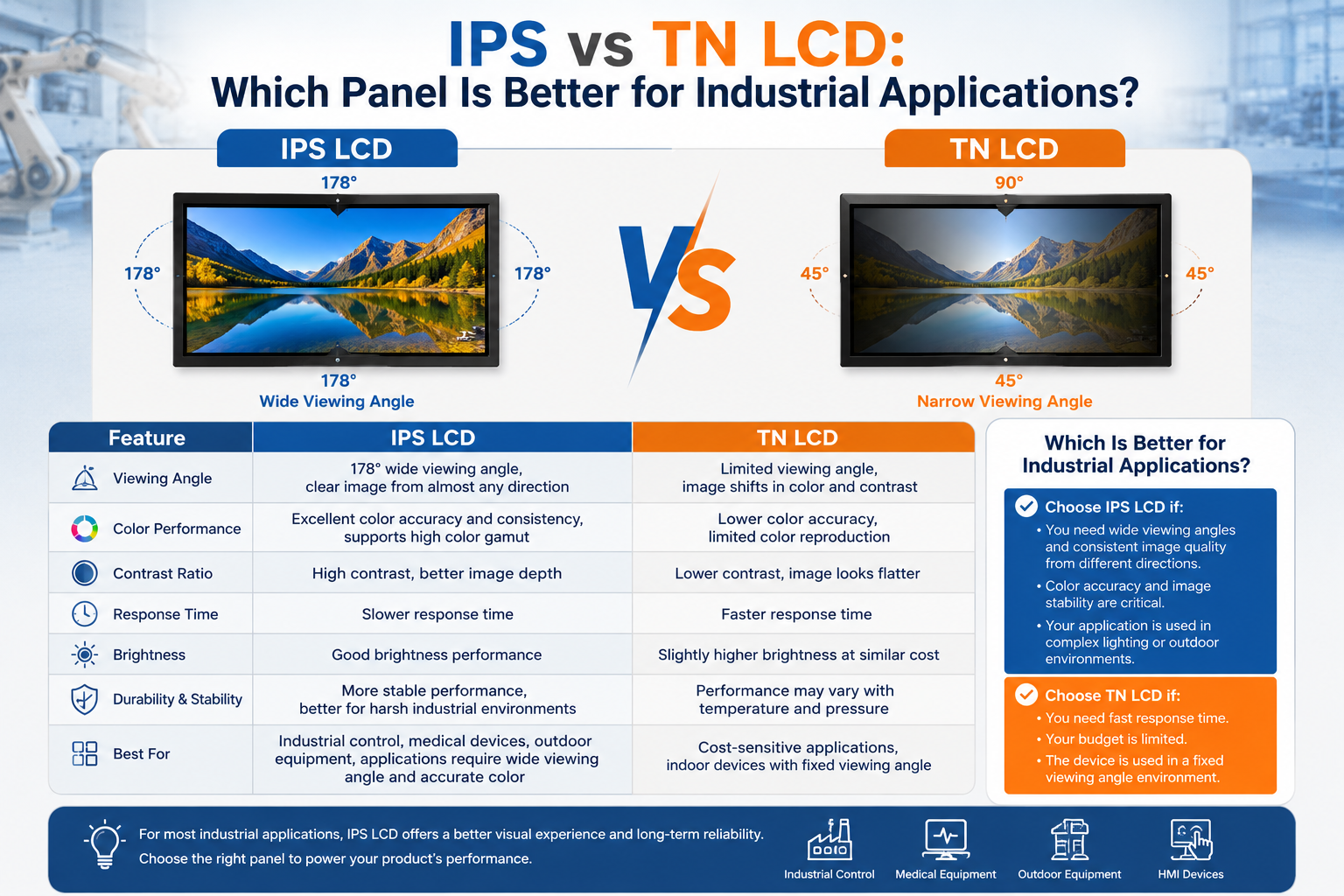
TN Panels: The biggest drawback is the narrow viewing angle. Effective viewing is only limited to the front 0–30° range. Once viewed from the side, the screen suffers from severe color distortion, brightness attenuation, and grayscale inversion. In industrial scenarios requiring multi-person observation or wall-mounted/floor-mounted display equipment, this defect greatly affects operational efficiency.
IPS Panels: Features a industry-leading178° ultra-wide viewing angle (both horizontal and vertical). The brightness, color tone, and grayscale of the screen remain almost unchanged from any viewing angle. It perfectly adapts to complex industrial operation postures and multi-person collaborative viewing needs, ensuring accurate information acquisition at all times.
2.2 Color Reproduction & Display Accuracy
TN Panels: Restricted by technical structure, TN panels have low color gamut coverage, poor color gradation, and single color presentation. They cannot restore subtle color differences, and grayscale display is prone to distortion. For industrial scenarios with no color recognition requirements, its display performance is sufficient, but it cannot meet high-precision visual detection needs.
IPS Panels: Supports high-precision 8-bit/10-bit color depth and full sRGB color gamut coverage, with accurate color reduction and delicate picture gradation. It can stably present subtle color and grayscale changes, which is essential for industrial visual inspection, medical imaging display, and precision instrument data visualization scenarios.
2.3 Response Speed & Dynamic Performance
TN Panels: This is its core advantage. The liquid crystal switching speed is extremely fast, with a response time as low as 1ms. It has almost no ghosting or smearing when displaying dynamic pictures, and has ultra-low latency. It is very suitable for high-frequency dynamic data refresh and real-time monitoring scenarios.
IPS Panels: Traditional IPS panels have a slightly slower response time (4–8ms) than TN panels. However, with the iteration of Fast IPS technology, the dynamic response gap has been greatly narrowed. For most industrial static data display and low-speed dynamic monitoring scenarios, its dynamic performance is completely sufficient.
2.4 Power Consumption & Cost
TN Panels: Simple structure and high light transmittance reduce the brightness requirement of the backlight module, resulting in lower power consumption and lower manufacturing costs. It is the most cost-effective choice for low-budget, low-power industrial equipment.
IPS Panels: The horizontal liquid crystal arrangement reduces light transmittance, requiring a higher-power backlight to achieve the same brightness as TN panels, leading to slightly higher power consumption. Meanwhile, the complex process increases production costs, making its overall procurement cost 20%–40% higher than TN panels of the same specification.
2.5 Touch Stability & Industrial Durability
TN Panels: Belongs to soft screens. Pressing the screen will cause obvious water ripples and liquid crystal distortion. The surface pressure resistance is poor, and long-term frequent touch operation is prone to display anomalies, so it is not suitable for high-frequency touch interaction scenarios.
IPS Panels: Known as hard screens, with stable internal liquid crystal structure. No water ripples or distortion under surface pressure. It has excellent pressure resistance, scratch resistance, and anti-interference ability, adapting to frequent touch operations and harsh industrial operating environments, with longer service life and more stable long-term performance.
3. Applicable Industrial Scenarios: How to Choose?
There is no absolute "better" between IPS and TN panels—only more suitable scenarios. Based on their performance characteristics, we summarize the optimal application fields for the two panels to help precise selection.
3.1 Preferred Scenarios for TN LCD Panels
TN panels are ideal for cost-sensitive, single-view, static data display industrial scenarios with low display quality requirements:
- Simple industrial instrumentation: Temperature detectors, pressure gauges, humidity sensors, and other single-data display devices
- Fixed-angle monitoring equipment: Single-operator desktop industrial control terminals with fixed viewing positions
- Low-power embedded devices: Portable industrial detection equipment, battery-powered field instruments
- Low-budget automation equipment: Ordinary assembly line indicator screens, simple control panels
In these scenarios, the narrow viewing angle and poor color performance of TN panels have no impact on equipment operation, while its low cost and low power consumption bring significant cost advantages for mass production.
3.2 Preferred Scenarios for IPS LCD Panels
IPS panels are the preferred choice for high-reliability, multi-angle viewing, high-precision display, and high-frequency interaction industrial scenarios:
- High-end industrial HMI: CNC machine tool operation screens, robotic control panels, factory central control displays requiring multi-person viewing
- Precision detection & medical equipment: Industrial visual inspection equipment, medical diagnostic displays, experimental analysis instruments requiring accurate color restoration
- Outdoor & complex environment equipment: Outdoor monitoring terminals, vehicle-mounted industrial displays, workshop wall-mounted large-screen terminals with variable viewing angles
- High-frequency touch interactive devices: Intelligent industrial terminals, self-service industrial operation screens, man-machine interactive equipment requiring long-term stable touch
For industrial equipment related to production safety, precision detection, and human-computer interaction, the high stability and high display quality of IPS panels can effectively avoid operational errors caused by display deviation and improve industrial operation safety and efficiency.
4. Comprehensive Pros & Cons Summary
4.1 TN LCD Pros & Cons
Pros: Ultra-fast response speed, ultra-low latency, mature and stable technology, low production cost, low power consumption, high optical efficiency, suitable for mass industrial production.
Cons: Narrow viewing angle, serious color shift from side view, poor color accuracy and grayscale performance, soft screen structure, poor pressure resistance, unsuitable for high-frequency touch and high-precision display scenarios.
4.2 IPS LCD Pros & Cons
Pros: 178° ultra-wide viewing angle, consistent color and brightness in all directions, high color accuracy and delicate display, hard screen anti-pressure structure, stable touch performance, strong environmental adaptability, long service life, high industrial reliability.
Cons: Slightly higher cost than TN panels, relatively higher power consumption, traditional models have slightly slower response speed than TN panels (largely optimized by Fast IPS).
5. Final Selection Guidelines for Industrial Users
To simplify the selection process for industrial engineers and buyers, we conclude with clear selection principles:
Choose TN LCD if: Your project has a tight budget, the display is viewed from a fixed front angle only, the equipment requires low power consumption, and the display content is simple data and text with no high color accuracy requirements.
Choose IPS LCD if: Your equipment requires multi-angle viewing, high-precision color and grayscale display, frequent touch interaction, long-term stable operation in complex environments, and high industrial reliability standards, even with a slightly higher budget.
6. Conclusion
In the industrial display field, TN and IPS panels have their own market positioning and application values. TN panels remain the cost-effective choice for basic industrial display scenarios relying on mature technology and low power consumption. IPS panels have become the mainstream of mid-to-high-end industrial displays by virtue of their wide viewing angle, high color accuracy, and strong structural stability.
With the upgrading of industrial automation and intelligent manufacturing, industrial displays are putting forward higher requirements for interaction performance and display accuracy. IPS panels are gradually expanding their market share, while TN panels still maintain irreplaceable advantages in low-end and cost-sensitive industrial scenarios. Reasonable selection based on actual equipment needs and application environments is the key to maximizing the cost performance of industrial display solutions.
industrial display:https://www.idtdisplay.com/