Comparing Touch Display Technologies: G/G, OGS, oTP, and iTP Explained

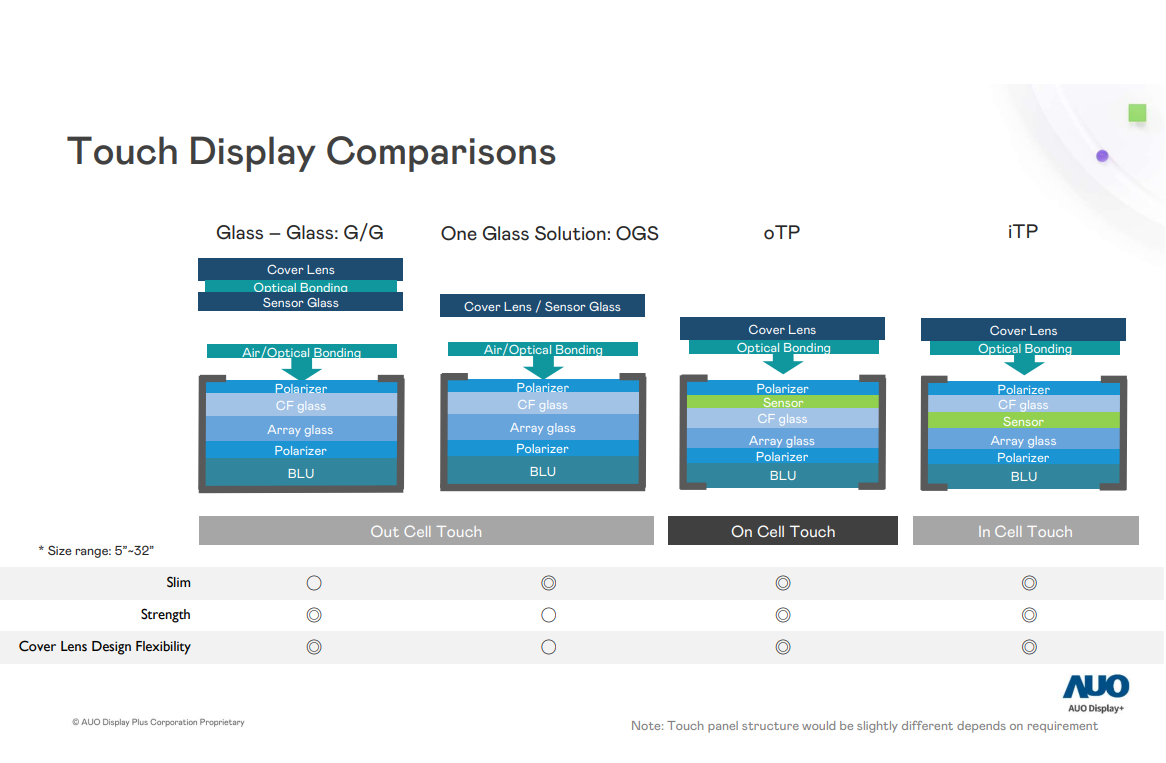
Compares different types of touch display technologies: Glass-to-Glass (G G), One Glass Solution (OGS), Optical Touch Panel (oTP), and In-Cell Touch Panel (iTP) Each of these technologies uses distinct configurations of layers for the construction
Comparing Touch Display Technologies: G/G, OGS, oTP, and iTP Explained
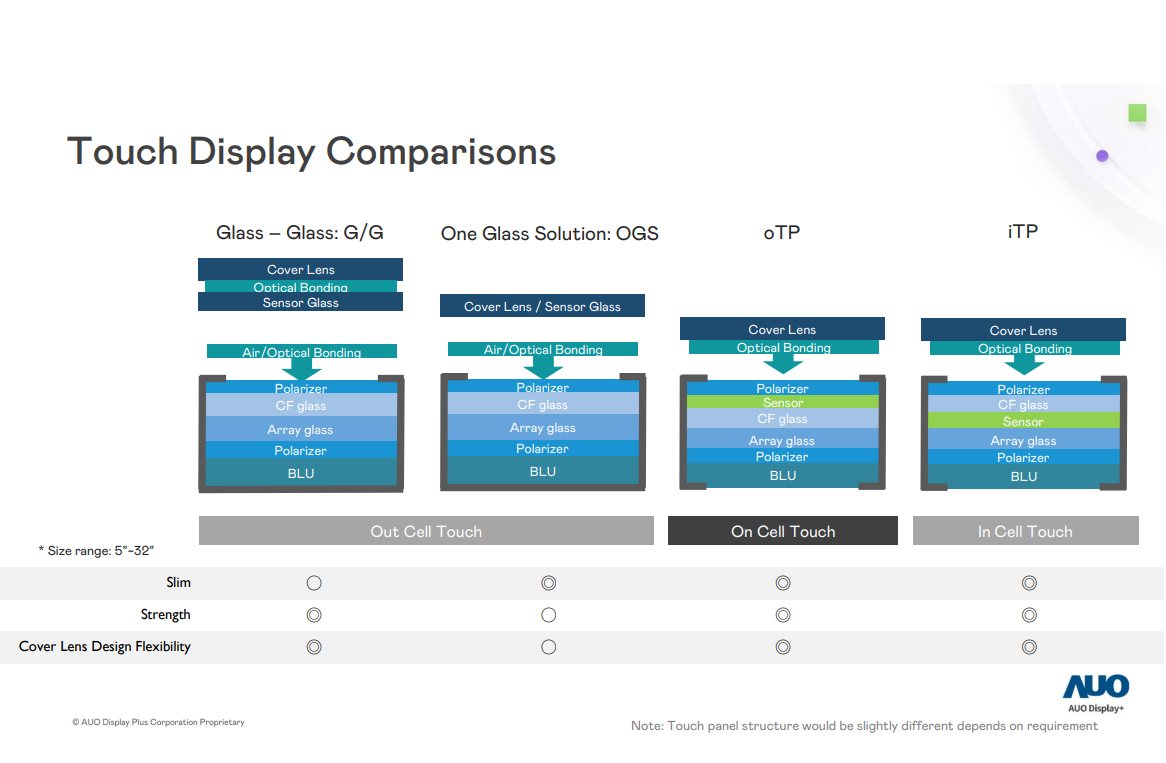
Compares different types of touch display technologies: Glass-to-Glass (G/G), One Glass Solution (OGS), Optical Touch Panel (oTP), and In-Cell Touch Panel (iTP). Each of these technologies uses distinct configurations of layers for the construction of a touchscreen display.
Here’s a breakdown of the main points from the image:
1. Glass-to-Glass (G/G)
Layers: The G/G configuration involves a cover lens, optical bonding, and sensor glass.
Technology: This traditional structure separates the glass and the sensor, making it typically bulkier but potentially more durable. It is suited for larger displays, with a size range from 5" to 32".
Strength and Flexibility: The G/G configuration offers excellent strength but lacks the same level of design flexibility compared to other solutions.
Touch Sensitivity: The touch functionality relies on an air/optical bonding mechanism between the sensor glass and the display, which is generally used in out-cell touch configurations.
2. One Glass Solution (OGS)
Layers: This configuration reduces the complexity of the setup by combining the cover lens and sensor glass into a single layer.
Technology: It is designed to be slimmer and lighter than the G/G option, with improved optical clarity due to the air/optical bonding. However, the use of polarizer and CF glass may result in some compromises in terms of strength.
Touch Sensitivity: Like G/G, the OGS configuration supports out-cell touch but in a more compact form.
3. Optical Touch Panel (oTP)
Layers: The oTP configuration uses optical bonding directly to the cover lens, polarizer, and sensor glass, with fewer intermediary layers compared to the G/G and OGS configurations.
Technology: The oTP technology enables a more seamless integration of touch capabilities, which is great for on-cell touch applications. This design is optimized for flexibility in size and touch performance, but it might not be as robust as other configurations.
Strength and Flexibility: The oTP offers good design flexibility, making it suitable for many different applications in consumer electronics.
4. In-Cell Touch Panel (iTP)
Layers: iTP configurations integrate the touch sensor directly within the array glass. The layers are typically reduced to cover lens, optical bonding, and a polarizer over the sensor.
Technology: iTP technology allows for a thinner overall display and enhanced durability due to fewer layers, making it ideal for modern smartphones and high-performance devices.
Touch Sensitivity: The iTP configuration supports in-cell touch, offering a higher level of touch sensitivity and responsiveness due to the integration of the sensor into the display itself.
Key Features of All Configurations:
Size Range: All the configurations support a size range between 5”-32”.
Touch Types: While out-cell touch (external sensor) is typical for G/G and OGS, both on-cell and in-cell touch (integrated touch sensors) are available in oTP and iTP configurations, offering higher integration levels and improved touch sensitivity.
Slimness and Strength: There is a balance between slimness and strength in each of these technologies. G/G tends to be stronger, but the OGS, oTP, and iTP are more compact.
Conclusion:
Each of these touch display technologies has its strengths and weaknesses. For example, Glass-to-Glass is ideal for durability and larger displays, while One Glass Solution offers a slimmer design. The Optical Touch Panel configuration blends flexibility with optical clarity, while the In-Cell Touch Panel provides the thinnest and most responsive touch experience. The choice between these technologies depends on the desired trade-off between size, strength, and touch performance.
Touch lcd display:https://www.idtdisplay.com/products/industrial_touch_screen/