What is difference between built-in and external constant current source?

"Built-in constant current source " and "external constant current source " of LCD screens is whether the driving circuit and power supply are integrated inside the LCD screen module or need to be separately equipped external
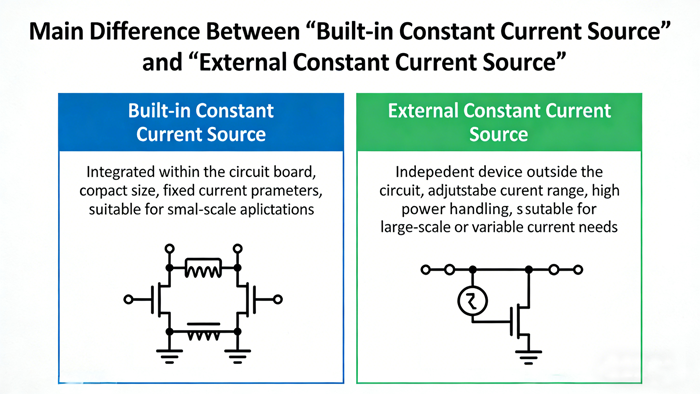
What is the main difference between "built-in constant current source" and "external constant current source"?
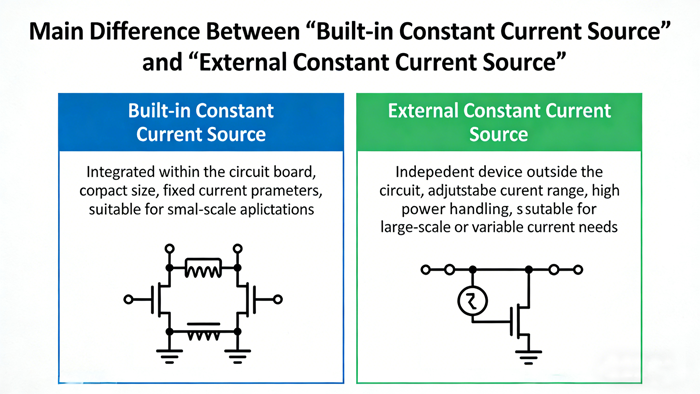
The main difference between the "built-in constant current source" and "external constant current source" of LCD screens is whether the driving circuit and power supply are integrated inside the LCD screen module or need to be separately equipped externally. Simply put, their core differences lie in integration and applicable scenarios.
LCD screen built-in constant current source vs external constant current source: core difference
Simply put, the built-in constant current source=driver circuit is made on the screen board; The external constant current source=driver circuit is located on the motherboard/driver board, and there are significant differences in structure, cost, heat dissipation, and maintenance between the two.
1. Different structural positions
Built in constant current source (Built in LED Driver)
The LED backlight driver chip and constant current circuit are directly integrated onto the backlight board/PCB of the LCD screen, and the screen body comes with its own driver.
Power supply generally only requires supplying the main voltage (such as 12V) to the screen, and the screen completes constant current control by itself.
External constant current source (External LED Driver)
The constant current drive circuit is located on the motherboard, driver board, and independent driver box,
The screen is only responsible for emitting light, and the current is controlled by an external board.
2. Wiring and interfaces
Built in: with few wires, usually a single row socket, power supply and signal enter the screen together, simple and tidy.
External: An additional set of LED backlight control cables requires separate connection to the driver board, making the wiring more complex.
3. Brightness adjustment method
Built in: mostly PWM/DC dimming, implemented by the internal circuit of the screen, with good dimming consistency.
External: The motherboard sends a signal to control the external driver, and the dimming accuracy depends on the motherboard solution.
4. Heat dissipation and stability
Built in: The driver chip is attached to the side of the screen, with small heat dissipation space, and high-power, high brightness screens are prone to overheating.
External: The driver is located on the motherboard for better heat dissipation and is more suitable for high brightness, multi bead backlighting.
5. Cost and universality
Built in: The screen cost is slightly higher, but the whole machine eliminates the driver circuit, making it more cost-effective for bulk production.
External: The screen is cheaper, but the whole machine requires an additional driver board, which is suitable for small batches and flexible screen replacement.
6. Maintenance and replacement
Built in: If the driver is broken, the entire screen needs to be replaced, resulting in high repair costs.
External: If the driver is broken, only replace the driver board, and the screen can continue to be used for easier maintenance.
7. Summary of applicable scenarios
Built in constant current source
Commonly used for: industrial control screens, vehicle mounted screens, integrated modules, standard industrial LCD screens
Advantages: concise, stable, strong anti-interference, and user-friendly wiring for customers
External constant current source
Commonly used for DIY displays, televisions, low-cost devices, and flexible screen matching projects
Advantages: Universal screen, cheap maintenance, good heat dissipation
In order to help you understand more clearly, I have organized their differences into the following table:
Comparative dimension | Built in constant current source | External constant current source |
Definition and Integration Degree | The driving circuit (DC/DC converter, constant current IC) is directly integrated on the PCB board or FPC flexible cable of the LCD screen module, and the display interface usually only provides power and enable signals. | The constant current driver circuit is designed as an independent circuit board, such as a constant current board, or requires engineers to build it on the motherboard (driver board) themselves. The display interface needs to be connected to the current after driving. |
Applicable scenarios | Mainly used for portable devices such as mobile phones, digital cameras, game consoles, and smaller LCD screens (such as 10 inches or less). | Commonly seen in medium to large-sized display screens, such as laptops, monitors, televisions, industrial control screens, etc., these applications require higher brightness and driving power. |
Design Complexity | The design is simple. For end users or system integrators, there is no need to worry about complex constant current circuit designs, they can work directly by supplying power. | The design is complex. Engineers need to master professional knowledge such as boost/buck topology, inductor selection, and current feedback loop design to ensure the stability and efficiency of the circuit. |
Cost and flexibility | The cost is relatively high (reflected in the price of the screen), but the flexibility is low. The driving capability is fixed on the screen and cannot be easily replaced or adjusted. | Low cost (independent board solution), high flexibility. Suitable driver boards or circuit designs can be selected according to actual needs, which is also convenient for maintenance and replacement. |
Efficiency and heat dissipation | For small-sized screens, in order to pursue low power consumption, linear constant current sources or charge pumps are often used, with decent efficiency, but severe heating under high current. The heat dissipation challenge of small-sized integrated solutions is relatively controllable. | Medium to large-sized solutions commonly use DC-DC switch constant current sources, with an efficiency of over 80% -95% and low heat generation, making them more suitable for driving long string LED light strips. |
Brightness consistency and accuracy | A highly integrated driver chip combined with a fine circuit layout can achieve very high constant current accuracy, ensuring the brightness uniformity of small-sized screens. | By selecting high-precision constant current control chips and sampling resistors, current matching accuracy of ± 5% or even higher can be achieved to meet professional display requirements. A well-designed circuit can fully ensure the uniformity of large-sized screens. |
Protection function | In order to save space, the protection function of the built-in solution may be relatively basic. However, many integrated chips also incorporate overcurrent and overvoltage protection. | Mature independent drive solutions typically design more comprehensive protection circuits, such as overvoltage protection (OVP), overcurrent protection (OCP), surge suppression, etc., to cope with complex grid environments and potential load failures, with higher reliability. |
Going deeper: How to understand this difference?
This differentiation in design is essentially a trade-off between standardization and customization.
The built-in constant current source is more like a "turnkey" solution. The manufacturer has completed the optimal driver design based on the specific screen size, LED quantity, and electrical characteristics. This is crucial for portable products that pursue miniaturization, low power consumption, and fast time to market.
The external constant current source embodies the engineering concept of "divide and conquer". It separates the universal power conversion and control functions, allowing the screen itself to focus on display. In this way, the same screen can be paired with different driver boards to meet various voltage, brightness, and protection requirements, which also facilitates later maintenance and upgrades.
I don't know if you need to make a selection when designing the circuit, or if you encountered related issues during maintenance? If you can tell me the specific application scenario or screen model, I can give you more targeted advice.
Industrial LCD screen:https://www.idtdisplay.com/
AUO LCD screen:https://www.idtdisplay.com/products/AUO_LCD_Displays/