Technical principle of mini LED

The technical principle of Mini LED can be understood as a precision transformation of the traditional LCD screen backlight system It did not change the display mode of the screen,
Technical principle of mini LED
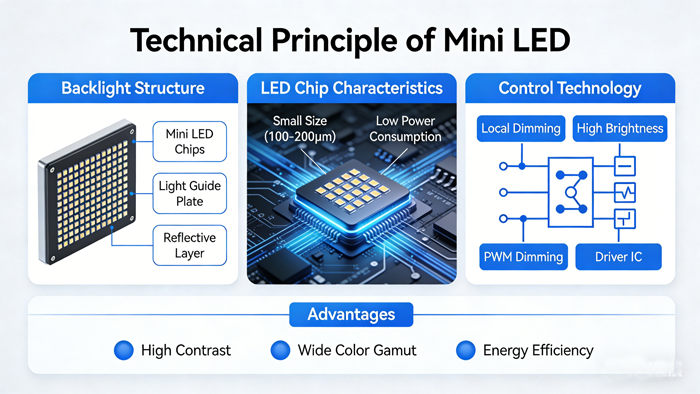
The technical principle of Mini LED can be understood as a precision transformation of the traditional LCD screen backlight system. It did not change the display mode of the screen, but upgraded the light source behind it from a "crude big light bulb" to an "intelligent matrix composed of countless tiny light beads".
This process can be broken down into three key steps: from the source of light at the hardware level, to the control of light at the control level, and finally to the presentation of the fruit of light. The entire system is like a top-level symphony orchestra that cooperates seamlessly.
Source of Light: Smaller, More Efficient, and More Accurate "Musicians"
This is the cornerstone of Mini LED technology. Firstly, it shrinks traditional millimeter sized LED beads to 50-200 microns (approximately the thickness of a human hair). This allows thousands of light beads to be accommodated on the same screen area, providing a hardware foundation for fine control.
But getting smaller is not enough, the lamp beads themselves also need to be more "excellent":
Improving luminous efficiency: By optimizing the epitaxial structure inside the chip, the "charge carriers" that generate light are arranged more neatly and in one place, thereby converting more electrical energy into light energy and reducing unnecessary losses.
Preventing sidewall leakage: When the chip is cut, the sidewall is prone to damage, leading to leakage. By using composite sidewall insulation technology, the chip sidewall is covered with "insulation protective clothing", reducing reverse leakage current by 10 times and ensuring that every penny of power is used for luminescence.
With these high-quality 'musicians', they can accurately play every note.
Control of Light: The "Command" and "Score" of Strategic Planning
With a large team of musicians, how to conduct becomes the core. This command system mainly consists of two parts:
Intelligent command of fine partitioning: Hundreds or thousands of light beads are divided into hundreds or thousands of independent backlight partitions. A powerful graphics chip or MCU control board will analyze every frame in real-time. Wherever it lights up, it commands the light beads in which zone to shine brightly; Wherever it should be dark, it will decisively turn off the lights in that area. This technology is called local dimming and is the key to achieving high contrast.
Efficient collaborative "scheduling mechanism": In order to accurately control massive partitions, engineers have designed an efficient driving scheme. For example, using dynamic scanning technology, like matrix scanning, to quickly control the on/off of each row and column of light beads in a time-sharing manner, can command more light beads with fewer driver chips, effectively reducing costs and heat.
Fruit of Light: Pure and Shocking 'Final Performance'
Under the collaboration of excellent "musicians" and top-notch "conductors", the final "performance" effect is naturally stunning:
Ultimate black field and ultra-high contrast: Due to the ability to independently turn off the backlight in specific areas, Mini LED can achieve a nearly "pure black" effect when displaying black, completely solving the problem of black and gray on traditional LCD screens. As a result, its contrast has been exponentially improved.
Delicate High Dynamic Range (HDR) performance: Thanks to a large number of LED chips, Mini LED screens can easily achieve peak brightness of 1000 nits or even higher. When playing HDR content, whether it's dazzling sunlight or dazzling lights, they can be realistically and stunningly restored.
Effective suppression of halo: Fine zoning controls light energy to minimize halo phenomena around bright objects to the greatest extent possible. Test data shows that at a distance of 10mm from the highlight area, the overflow brightness can decrease to two decimal places, indicating excellent light control ability.
Pure and uniform colors: In order to solve the tiny brightness and color differences between thousands of chips, intelligent algorithms are also used during manufacturing to "arrange" the chips, allowing chips with different characteristics to "complement each other", thereby ensuring that the color and brightness of the entire screen are uniform and consistent.
summary
Simply put, the technical principle of Mini LED is to construct a massive array of light sources through miniaturized LED chips, and use precise driving control to achieve massive levels of independent partition light control, thereby enabling traditional LCD screens to achieve a leap in core image quality indicators such as brightness and contrast.
In order to help you understand more intuitively, I have compiled a table of the various parts of this' symphony orchestra ':
Technical dimension | Core role | Key technology implementation | Effect achieved |
Source of Light (Hardware) | Highly skilled musicians | Chip miniaturization, optimized epitaxial structure to improve efficiency, sidewall insulation to prevent leakage | Integrate massive, efficient, and reliable light sources between square inches. |
Light Control (Driver) | The 'command' of strategic planning | Local dimming algorithm, massive backlight partitioning, dynamic scanning driver, intelligent layout to eliminate differences | Realize independent, precise, and real-time control of each tiny light source. |
Fruit of Light (Image Quality) | A breathtaking performance | The synergistic effect of integrated hardware and driver technology | Pure black with ultra-high contrast, stunning HDR brightness, excellent halo control, and uniform color expression. |
In addition to the mainstream white Mini LED, there is also a more advanced RGB Mini LED technology on the market, which directly uses red, green, and blue light beads to mix light and achieve more extreme color performance.