How to choose an outdoor LCD display screen that is visible under strong light

To choose a clear LCD display screen for outdoor strong light environments, it is indeed necessary to consider multiple factors comprehensively It is not just a simple "bright enough " issue
How to choose an outdoor LCD display screen that is visible under strong light?
To choose a clear LCD display screen for outdoor strong light environments, it is indeed necessary to consider multiple factors comprehensively. It is not just a simple "bright enough" issue, but a system engineering involving brightness, optical processing, and thermal management. I have sorted out the core points, hoping to help you clarify your thoughts.
Five core indicators for outdoor LCD selection
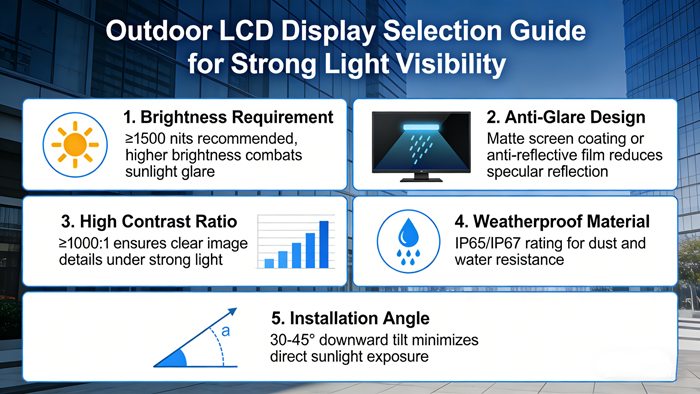
The following five core indicators are the key ones that you must confirm one by one when selecting:
key metrics | Why is it important | Outdoor selection suggestions |
Brightness | This is the most fundamental indicator. Under direct sunlight, the ambient light is extremely strong, and the screen brightness must be high enough to "suppress" the reflection and allow people to see the content clearly. | Starting at least 800 nits, we recommend 1000-1500 nits or higher. If the device is used under noon sunlight, it is recommended to directly consider models with 1500 nits or more. |
Reflection control | High brightness is not omnipotent. If the screen reflects light like a mirror, no matter how high the brightness is, it will be in vain. Controlling reflection is the key to improving readability. | Screen with AR (anti reflection) coating or AG (anti glare) treatment is preferred. This can greatly reduce specular reflection, turning glaring reflections into soft scattered light. |
Contrast and Black Position | Unable to see clearly under sunlight, often not because the white is not bright enough, but because the black is not black enough and the image appears gray. High contrast can make the picture more transparent. | Choose VA panel or high contrast IPS panel. At the same time, pay attention to the "black position performance" of the screen to ensure that black remains deep under strong light. |
viewing angle | In outdoor scenes, pedestrians may view the screen from various angles, and a narrow perspective can affect information transmission. | Preferred IPS panel, which can provide a wide viewing angle of about 170 °, ensuring that the color and brightness of the image will not be severely distorted when viewed from all angles, including top, bottom, left, right, etc. |
Operating Temperature | Outdoor equipment is exposed to direct sunlight, resulting in high internal temperatures. Ordinary screens may not be able to withstand it and may experience issues such as black screens and accelerated aging. | Industrial grade wide temperature products must be selected to ensure stable operation within a temperature range of -20 ℃ to 70 ℃ or even more stringent |
Advanced Technology: Good Plus Good 'Bonus Points'
In addition to the basic indicators mentioned above, the following technologies can further improve the performance of the screen outdoors. You can consider them based on your budget and needs:
Full lamination technology: This technology uses optical adhesive to seamlessly bond the touch screen and LCD panel together, eliminating the air layer in between. It can effectively reduce internal reflection, making the image look like it is "stuck" on glass, significantly improving readability and visual transparency under strong light, and is a standard configuration for high-end outdoor equipment.
Automatic brightness adjustment: The built-in light sensor on the screen can automatically adjust the screen brightness based on the strength of ambient light. For example, when the sunlight is strong at noon, the brightness is automatically adjusted to full, and when the light is dim in the evening, the brightness is reduced to save energy and reduce heat, which is very intelligent and practical.
Semi reflective and semi transparent technology: This is a special design that allows the screen to display by reflecting ambient light during the day, with almost no power consumption; Turn on the backlight again in the dark. For outdoor handheld devices that pursue ultimate low power consumption, this is an ideal choice.
For example, recommendations for selecting a 7.0-inch screen
Clear brightness target: If your device is used outdoors, it is recommended to start from 1000 nits directly. If the budget allows, you can choose 1500 nits, so that you can handle any strong sunlight with ease.
Preferred IPS+full lamination: IPS panels ensure good color and wide viewing angle. If full lamination technology is added, the overall appearance of the screen will take another step forward, making both text and images clear and sharp.
Confirm touch and interface: If the device requires touch, it is best to choose a capacitive screen that supports wet hand and glove operation in outdoor environments. At the same time, confirm in advance whether the interface of the screen (such as LVDS, eDP) matches your main control board.
I hope this guide can help you find the appropriate screen. If you need more precise advice in specific application scenarios (such as in car, handheld devices, or fixed advertising machines), feel free to consult at any time.
auo lcd display:https://www.idtdisplay.com/products/AUO_LCD_Displays/
innolux lcd display:https://www.idtdisplay.com/products/innolux-lcd/