What are the differences in the production process of screen assembly and LCD mo

Although screen assemblies and LCD modules are often mixed, they have an upstream downstream relationship in the production process, with essential differences in complexity and integration Simply put, the LCD module is the core component of the screen
What are the differences in the production process of screen assembly and LCD module?
Although screen assemblies and LCD modules are often mixed, they have an upstream downstream relationship in the production process, with essential differences in complexity and integration. Simply put, the LCD module is the core component of the screen assembly, and the screen assembly is the final integrated and packaged product based on the LCD module.
Next, let's break down the production process of both in detail.
1. Differentiation of core concepts
Before discussing the process, first clarify the definitions of the two:
Liquid Crystal Module (LCM): This is the semi-finished or core component of a display screen. It precisely assembles liquid crystal panels (cells), backlight sources, driver ICs, polarizers, flexible circuit boards (FPCs), and printed circuit boards (PCBs) together to form a "display module" capable of displaying images. It requires an external motherboard and power supply to function.
Screen assembly: This is the ultimate display component that can be directly used, commonly found in consumer electronics products such as smartphones and tablets. It is based on the LCD module, further bonded with a touch screen (Touch Panel) and cover glass/Lens, forming a sturdy and directly touchable complete component.
Simple analogy: The LCD module is like an "engine", while the screen assembly is a "vehicle with the engine, tires, seats, and calibration installed".
2. Production process flow of liquid crystal module (LCM)
The manufacturing of LCD modules belongs to the module process of the display panel industry chain, and its core task is to "install" precision electronic and optical components onto LCD glass. The main process includes:
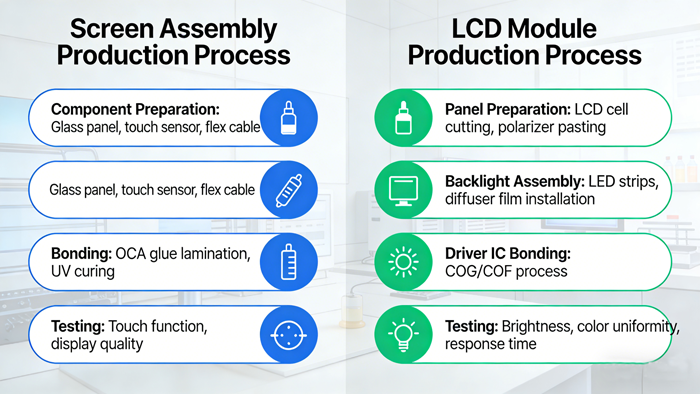
TFT glass and polarizer bonding: First, clean the cut LCD glass substrate, and then accurately attach vertical and horizontal polarizers on both sides, which is the key to allowing light to pass through the LCD layer correctly.
IC and FPC binding: This is one of the most precise steps. By using anisotropic conductive adhesive (ACF), the driver IC and flexible circuit board (FPC) are precisely aligned and pressed onto the edge of the liquid crystal glass. This process requires extremely high temperature and pressure to ensure electrical conductivity.
PCB board crimping: Connect the printed circuit board (PCB) to the other end of the FPC through crimping, providing control signals and power interfaces for the module.
Backlight assembly: Accurately assemble the assembled LCD glass components with a pre made backlight (consisting of a light guide plate, diffusion film, dimming film, adhesive frame, and LED light strip). The backlight source provides uniform backlight for the LCD panel.
Aging testing and inspection: The assembled module needs to undergo aging testing (Aging) and run at a specific temperature for a period of time to expose early faults in advance. Subsequently, a series of rigorous optical, electrical, and visual inspections were conducted to ensure that the module had no display abnormalities.
3. Production process flow of screen assembly
The production of screen assemblies is based on LCD modules, with the core being "integration" and "bonding". The process is as follows:
Prepare components: Prepare a fully functional LCD module and a separate touch screen panel (including outer cover glass and touch sensor).
Cleaning and pre-treatment: Deeply clean the outer surface of the LCD module and the inner surface of the touch screen to ensure no dust, as any dust can cause bubbles or defects after bonding.
Fit: This is the core technical link of the screen assembly process. Use a high-precision laminating machine to precisely laminate the touch screen onto the LCD module in a vacuum environment. The bonding methods can be divided into full bonding and frame bonding. Full bonding (such as OCA optical adhesive or OCR water-based adhesive) can eliminate air layers, significantly improve display performance and dust resistance.
Defoaming and curing: After bonding, the product may retain small bubbles, which need to be treated in a high-pressure and high-temperature defoamer to eliminate the bubbles. Afterwards, the optical adhesive is cured through methods such as ultraviolet (UV) irradiation.
Functional testing and final inspection: Conduct comprehensive functional testing on the assembled screen assembly, including touch sensitivity, multi touch, display effects (brightness, color, bad pixels), and anti-interference testing.
Summary: Comparison of Core Differences
To present them more clearly, we summarize their core differences in a table:
Dimension | Screen assembly | |
Product positioning | Core middleware/semi-finished products | Directly deliverable final components |
Core of craftsmanship | Precise electronic circuit connections (such as COG binding), optical assembly | High precision physical bonding (touch screen+cover plate) |
Main output | Display panel with driver circuit and backlight | Integrated touch function, can be directly used for assembling screen components |
Technical challenges | Micron level bonding, signal integrity, optical uniformity | Full lamination process in dust-free environment, eliminating bubbles, touch sensitivity |
Application scenarios | Products that require secondary development, or industrial/medical devices integrated with specific touch solutions | Consumer electronics products (mobile phones, tablets), integrated products with high requirements for integration and durability |
I hope this detailed comparison can help you understand the process flow of both more clearly.
AUO LCD DISPLAY:https://www.idtdisplay.com/products/AUO_LCD_Displays/
INNOLUX LCD DISPLAY:https://www.idtdisplay.com/products/innolux-lcd/