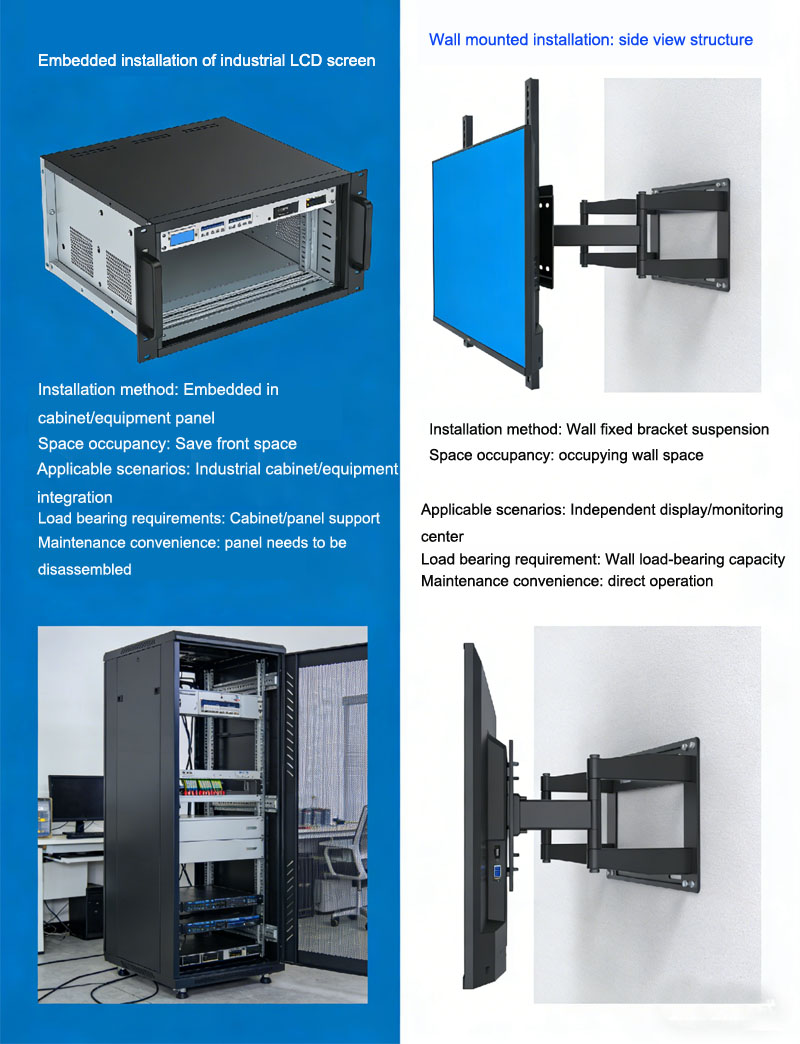
What is the difference between embedded installation and wall mounted installati

The core difference between embedded installation and flat installation (usually referring to wall mounted) of industrial LCD screens is that the former embeds the screen into a panel or cabinet, integrating it with the environment; The latter fixes the s
What is the difference between embedded installation and wall mounted installation of industrial LCD screens?
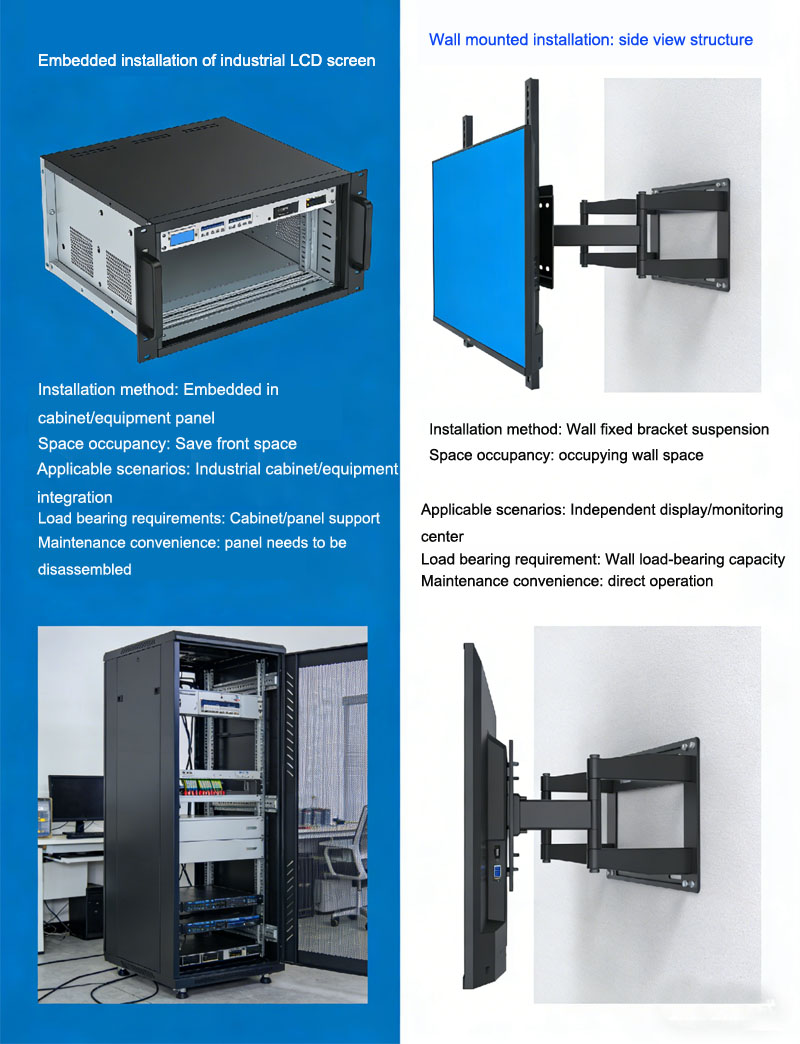
The core difference between embedded installation and flat installation (usually referring to wall mounted) of industrial LCD screens is that the former embeds the screen into a panel or cabinet, integrating it with the environment; The latter fixes the screen on the wall or bracket, separated from the supporting surface.
For your convenience in quickly grasping the key points, the core differences between the two are compared as follows:
Comparative dimension | Embedded installation | Wall-mounted installation |
Core Definition and Appearance | The screen is embedded in the installation surface (such as cabinet, equipment panel), with a flat surface, forming a whole. | The screen is fixed on the wall or pole through a bracket, and protrudes from the support surface. |
Stability and Protection | Excellent. Strong impact and vibration resistance, high dust and waterproof performance (up to IP65 or above). | Good. However, under long-term vibration, the bracket may loosen, and attention should be paid to supporting conditions such as load-bearing walls. |
Space utilization | Save space. No additional occupation of external space. | Occupying external space. The screen protrudes from the wall, and the operating space needs to be considered. |
Installation and Maintenance | Complex. Accurate reserved openings are required, and later replacement may require modification. | simple and convenient. Quick deployment, easy to disassemble, maintain or upgrade separately. |
Perspective and flexibility | Fixed angle, unable to adjust | Flexible and adjustable. The bracket usually supports adjustment of height, pitch angle, etc |
Typical Applicable Scenarios | Industrial automation equipment, control cabinets, medical instruments, outdoor terminals, and other scenarios with limited space and harsh environments | Workshop monitoring center, warehouse information screen, command and dispatch center, scenes requiring multi screen splicing or pre maintenance |
How to choose the appropriate installation method
You can make quick decisions based on the following four steps:
1. Evaluate the environment: If there is high vibration, dust, or liquid splashing risk on site (such as in mines or workshops), embedded systems are preferred. Both are acceptable in ordinary indoor environments.
2. Clarify maintenance requirements: If frequent disassembly, upgrading, or maintenance is required (such as information release screens), wall mounted systems have obvious advantages.
3. Calculate space cost: Embedded systems are the only option for space sensitive areas such as control cabinets and small workstations. If there is ample space on the wall or floor, wall mounted or floor standing brackets are more flexible.
4. Consider scalability: When there is a need for multi screen splicing or integration of peripherals such as keyboards and barcode scanners, wall mounted with hydraulic brackets or bracket based solutions are easier to implement.
Additional explanation: Embedded segmentation and flexible products
Subdivision of Embedded Systems: Embedded systems can also be divided into "embedded" (devices fully embedded, flat and integrated) and "embedded" (screens with borders, embedded on the surface). Embedding is more aesthetically pleasing and provides better protection, but disassembly needs to be done from the inside; External embedding is relatively easy to disassemble and maintain from the outside.
Flexible product selection: Many industrial displays on the market support multiple installation methods simultaneously. For example, some models can be embedded with screws and come with a standard VESA interface on the back (a universal mounting hole standard), which can be easily converted to wall or bracket installation. You can pay attention to this feature when making a purchase.
If you could share specific scenarios where you plan to use industrial screens (such as for machine tool control, logistics sorting dashboards, or laboratory equipment), I can provide you with more specific suggestions.
AU LCD screen:https://www.idtdisplay.com/products/AUO_LCD_Displays/
INNOLUX LCD Screen:https://www.idtdisplay.com/products/innolux-lcd/