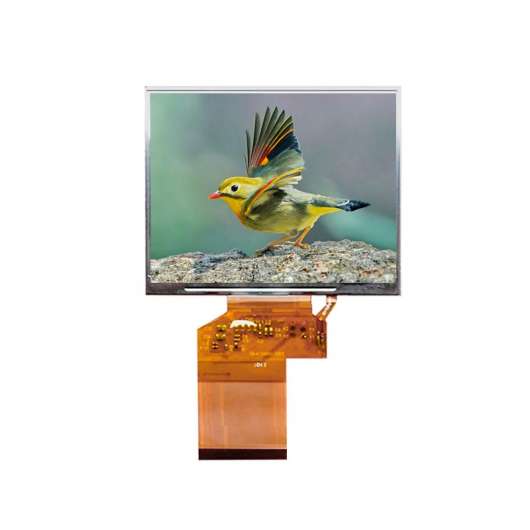
Is it better for the viewing angle of a 3.5-inch LCD screen to be larger?

The viewing angle of an LCD screen is not unconditionally "the larger the better " It is a parameter that requires a trade-off with application scenarios, cost, and other performance factors
The viewing angle of an LCD screen is not unconditionally "larger is better". It is a parameter that requires a trade-off with application scenarios, cost, and other performance factors.
Core trade-off: The relationship between viewing angle and key parameters
To facilitate your understanding, the following table compares the main differences between wide-viewing angle (represented by IPS technology) and standard viewing angle (represented by TN technology) screens:
Feature dimension | Wide-viewing angle screen (such as IPS technology) | Normal viewing angle screen (such as TN technology) |
Viewing angle quality | The advantages are obvious. It can usually achieve 178°/178°, with minimal color and brightness changes when viewed from the side. | When viewed from a small angle, color differences, reduced brightness, or color inversion are prone to occur when viewed from the side. |
Response speed | Relatively slow (millisecond level), imperceptible to ordinary applications, may be insufficient for extremely high-speed dynamic images (such as e-sports). | The advantages are obvious. With an extremely fast response speed (1-4ms), it is suitable for scenarios that require extremely fast image switching. |
Contrast | Usually moderate. | The native contrast ratio is relatively high, and the black color may appear darker. |
Cost | higher | Low and affordable. |
Power consumption | usually slightly higher | usually slightly lower |
How to choose a visual angle based on the scene?
The core principle of choosing a viewing angle is: match your way of viewing.
1. Scenarios requiring a wide viewing angle (recommended IPS or other wide viewing angle screens):
Devices for multiple users to view together: such as conference room display boards, public information inquiry machines, and cashier counters.
Devices with unfixed viewing directions: such as handheld mobile terminals and smart home panels with multi-angle adjustment capabilities.
Equipment with high requirements for color consistency: such as monitors used for professional adjustments in photography, design, and other fields.
2. Scenarios where a normal viewing angle is acceptable (TN screens may be considered to optimize cost or response speed):
Devices designed for fixed front-facing viewing: such as car central control screens, fixed industrial control panels, and ATM machines.
Scenarios where extreme response speed is pursued: such as dedicated devices for high-speed dynamic image processing.
Highly cost-sensitive mass consumer products.
Important precautions
The cost of "full viewing angle": Wide viewing angle technology typically incurs higher costs, slightly higher power consumption, and slightly slower response speed. If your device users always view it from the front, pursuing "full viewing angle 178°" may be an unnecessary waste of resources.
Focus on "effective viewing angle": Compared to the nominal maximum angle, it is more important to pay attention to the degree of brightness and color attenuation within the commonly used viewing angle range (such as 60 degrees on each side). For high-quality screens, the attenuation is more gradual.
Comprehensively consider other parameters: While paying attention to the viewing angle, it is necessary to make a comprehensive selection based on factors such as brightness, lifespan, cost, as well as response speed and power consumption that you have previously considered.
Summary and Recommendations
Viewing angle is an important indicator, but not the only criterion. The core lies in "just enough". When choosing:
First, clarify the primary viewing method of the equipment and the position of the viewer.
On the premise of meeting basic visual requirements, allocate the budget to more critical parameters (such as high brightness for outdoor use, long lifespan for industrial environments, and wide temperature range).
If you can specify the specific product or scenario in which this screen will be used, I can help you analyze the degree to which viewing angle should be prioritized.
AUO LCD DISPLAY:https://www.idtdisplay.com/products/AUO_LCD_Displays/