OLED vs LCD difference

OLED and LCD are two completely different display technologies, with their core differences stemming from fundamentally different light-emitting principles, which leads to a comprehensive performance comparison Simply put:
OLED and LCD are two completely different display technologies, with their core differences stemming from fundamentally different light-emitting principles, which leads to a comprehensive performance comparison. Simply put:
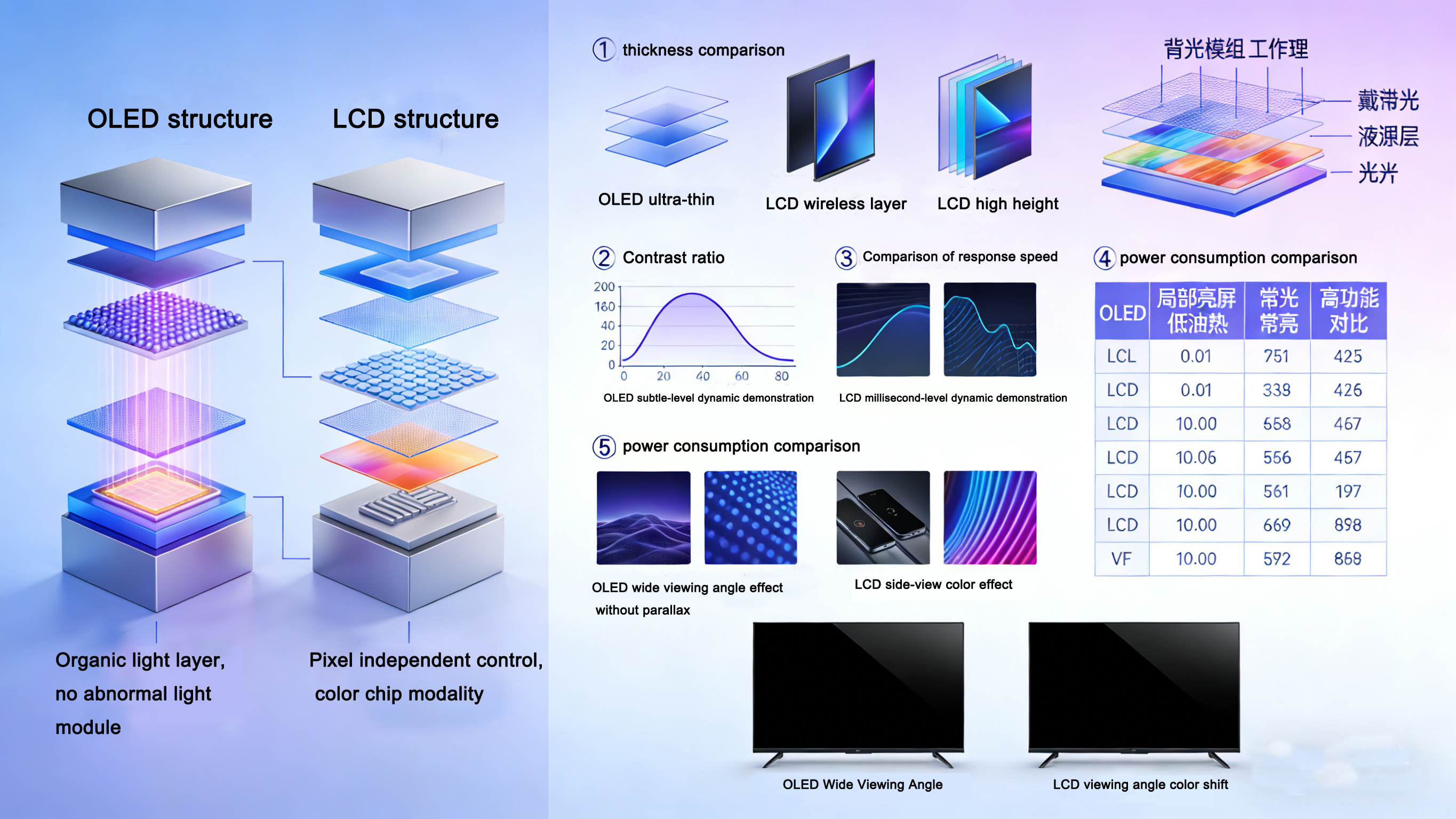
LCD (Liquid Crystal Display): Requires backlighting. The pixels themselves do not emit light; instead, they display images by controlling the transmission of backlight through the liquid crystal layer, which acts like a "shutter" to allow or block light.
OLED (Organic Light-Emitting Diode): Pixel self-luminescence. Each sub-pixel is a tiny organic light source that can be independently switched on and off.
Comparison Table of Core Differences
Feature dimension | OLED | LCD (including high-end Mini-LED) | Description and Impact |
Core principle | Organic material pixel self-emission | An independent backlight is required, with liquid crystal controlling the light | The difference in principles is the root cause of all characteristic differences. |
Contrast and black | With an almost infinite contrast ratio, black is completely non-luminous, achieving ultimate purity. | The contrast ratio is limited (typically ranging from 1000:1 to millions:1). When the backlight is blocked, black tends to exhibit a "halo" effect. | OLED has an overwhelming advantage in displaying dark scenes such as starry skies and night views, with a more transparent image. |
Response speed | Extremely fast (microsecond level), almost instantaneous response. | Slower (millisecond level), with slight smearing. | OLED is clearer when displaying high-speed motion images, making it the preferred choice for high-end gaming monitors. |
Viewing angle | Excellent, with almost no color and brightness degradation when viewed from the side. | Generally, when viewed from the side, there may be color shift and brightness reduction (IPS panels are better). | OLED is suitable for scenarios where multiple people are viewing from various angles. |
Color performance | The colors are vibrant and rich, with an extremely wide color gamut. | The color performance is excellent, but it is usually inferior to top-tier OLED. | Both high-end models have excellent colors, with OLED typically outperforming in terms of color accuracy and saturation. |
Brightness (HDR) | The peak brightness is high, but the sustained brightness across the entire screen is relatively low. It may be challenging to view under direct sunlight. | The full-screen continuous brightness is high. Products with Mini-LED backlighting can achieve ultra-high brightness, making them suitable for bright environments. | This is the key advantage of LCD at present, which is very important for HDR content and outdoor/bright scenes. |
Power consumption | Power consumption is related to the displayed content: it is very energy-efficient when displaying black or dark images. | The power consumption is relatively fixed, and the backlight is always on. | For mobile phones, OLED displays consume less power in dark mode; for televisions, it depends on the average brightness of the picture. |
Screen lifespan and "burn-in" | Organic materials will gradually age, and long-term display of high-brightness static images may lead to "burn-in" (residual image). | The backlight (LED) has an extremely long lifespan and basically poses no risk of "burn-in". | The short lifespan of OLED should be noted in situations where a fixed UI is displayed, such as television station logos and phone status bars. |
Thickness and Morphology | Simple structure, extremely thin, bendable, and foldable (flexible OLED). | It requires a backlight module and a liquid crystal layer, which are relatively thick and difficult to bend significantly. | OLED enables the realization of flexible screens, foldable screens, and roll-up screens. |
Cost and Price | The manufacturing process is complex, the cost is high, and it is usually more expensive for the same size. | The technology is mature, the cost is low, and the cost-performance ratio is high. | LCD has a huge price advantage in the mid-to-low-end market and large-sized TV sector. |
How to choose: Summary and scenario suggestions
The choice of technology depends entirely on your core needs and budget:
For those who prioritize ultimate picture quality and immersive experience for movie watching and gaming, OLED is the preferred choice. It offers the most striking contrast and response speed, especially in low-light environments.
If you need to watch in a very bright environment (such as a living room during the day), or are concerned about "burn-in" and pursue high-brightness HDR effects, consider opting for a high-end LCD TV/Monitor with Mini-LED backlighting. It offers a brighter viewing experience and is less prone to "burn-in".
With a limited budget, opting for a large size and high cost-effectiveness, traditional LCDs (such as IPS/VA panels) are a more affordable choice, with mature and reliable technology.
For mobile devices such as smartphones: high-end models generally adopt OLED to achieve features such as power saving, high contrast, and in-display fingerprint recognition; while mid-to-low-end models often use LCD to control costs.
Special form factor requirements (foldable screen, roll-up screen): Currently, only flexible OLED can achieve this.
In industrial or professional application scenarios (in conjunction with your previous question), additional considerations are needed:
LCD: Due to its high brightness potential, long lifespan, no risk of "burn-in", mature and stable technology, and controllable cost, it remains the absolute mainstream in industrial displays, especially for outdoor sunlight-viewable screens.
OLED: Due to its potential lifespan issues, challenges in achieving ultra-high brightness, and higher costs, it is less commonly used in harsh industrial environments that require 24/7 stable operation, and is more commonly seen in professional equipment with special requirements for volume and form.
If you could inform me of the primary purpose you have in mind for the monitor (such as home audio-visual entertainment, professional design and drawing, or a specific industrial environment), I can provide you with more specific model or technical route recommendations.
TFT LCD:https://www.idtdisplay.com/
AUO LCD:https://www.idtdisplay.com/products/AUO_LCD_Displays/