Design of 4-wire resistive touch screen structure

The structural design of the four wire resistive touch screen cleverly utilizes two orthogonal ITO resistive films, precise isolation points, and a time-sharing voltage measurement circuit The core idea is to connect circuits through mechanical contact
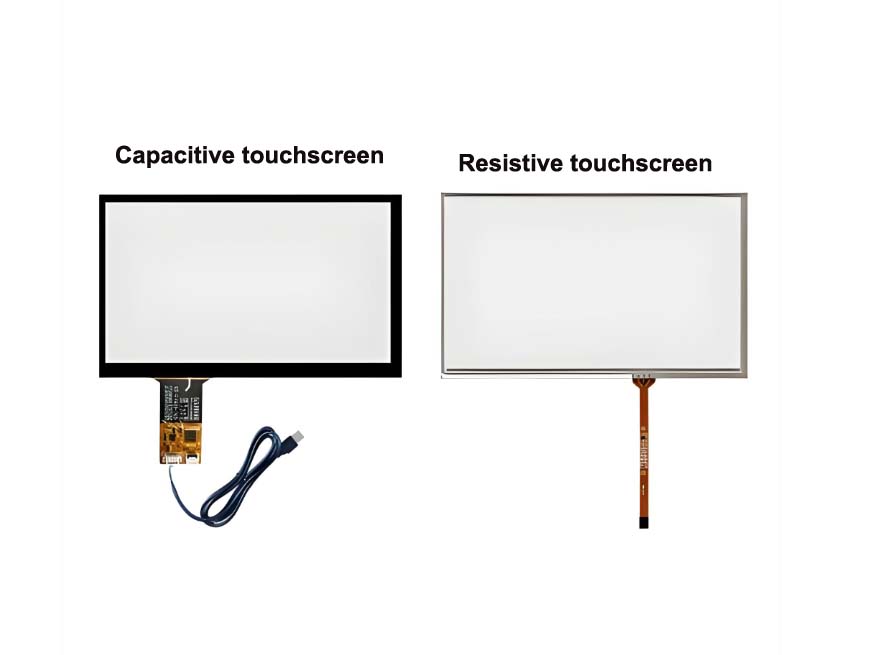
The four wire resistive touch screen is a classic, low-cost, and technologically mature touch solution. Its structural design is relatively simple but very exquisite. The following is a detailed breakdown of its structural design:
Core structure: Two layers of ITO conductive thin film
The core of the entire screen is a flexible film (usually PET) coated with two transparent conductive layers of indium tin oxide. The ITO layer has uniform resistance characteristics.
Upper film (touch layer)
Material: Flexible PET film.
Coating: The bottom surface is coated with ITO.
Feature: Two parallel silver paste lines are etched on the left and right sides of the bottom ITO layer, forming equipotential electrodes in the X direction. The bottom surface (ITO surface) of this film faces downwards.
Lower layer film (substrate layer)
Material: Usually thicker PET film or glass substrate (for flatness).
Coating: The top surface is coated with ITO.
Feature: Two parallel silver paste lines are etched on the upper and lower sides of the top ITO layer, forming equipotential electrodes in the Y direction. The top surface (ITO surface) of this thin film is facing upwards.
Key components and design points
isolation point
Function: Ensure that the upper and lower ITO layers are insulated and not in contact when not touched, to prevent accidental triggering.
Design and layout:
Made of fine insulating materials (such as plastic particles) with a diameter of approximately 0.01mm.
Uniformly distributed in matrix form on the surface of the lower ITO layer.
The density is high enough to ensure that the two layers of film are parallel and not adhered to each other; But it cannot be too high, so as not to affect the sensitivity of contact when touched.
Adhesive border
Function: Firmly bond the edges of the upper and lower layers of film, seal the internal structure, and prevent dust and moisture from entering.
Design: Use high-strength double-sided tape to form a sealed frame around the screen. The border needs to leave an outlet for electrode leads.
Electrodes and leads
The upper and lower layers of thin film each have two electrodes (a total of four, hence the name 'four wire').
Electrodes are usually printed with silver paste with better conductivity to reduce bus resistance.
The electrodes are connected to the touch screen controller through flexible circuits or wires.
Top covering film
On top of the upper PET film, a hard and wear-resistant transparent coating (such as polyester or glass coating) is usually added to protect the soft PET layer from scratches.
Working principle (closely related to structure)
X-coordinate measurement:
The controller applies a reference voltage (Vref) to the two electrodes of the lower layer (Y layer) to form a uniform electric field in the Y direction.
Ground the left electrode of the upper layer (X layer) and suspend or set the right electrode to high impedance.
When a user touches a certain point, the two layers of ITO come into contact under pressure.
At this point, the voltage of the lower layer (Y layer) is "conducted" to the upper layer (X layer) through the contact point.
The controller measures the voltage value from the upper right electrode, which is proportional to the position of the touch point in the Y direction, to calculate the Y coordinate.
Y-coordinate measurement:
Switching circuit: Apply a reference voltage to the two electrodes of the upper layer (X layer) to form a uniform electric field in the X direction.
Ground the upper electrode of the lower layer (Y layer) and suspend or set the lower electrode to high impedance.
Similarly, through the contact point, the upper layer voltage is conducted to the lower layer.
The controller measures the voltage value from the lower electrode of the lower layer, which is proportional to the position of the touch point in the X direction, in order to calculate the X coordinate.
Simple memory: measure Y using X layer (voltage from Y layer), measure X using Y layer (voltage from X layer).
Advantages and disadvantages of structural design
Advantages:
Simple structure and low cost.
It can respond to the touch of any object (fingers, gloves, stylus).
Extremely low power consumption.
Minor scratches on the surface do not affect use.
Disadvantages (directly related to the structure):
Limited durability: The repeated bending of flexible films and fatigue of ITO layers result in a shorter lifespan (typically millions of touches).
The light transmittance is relatively low (about 80%), and the optical clarity is not as good as that of capacitive screens.
Does not support multi touch.
Requires some pressure, light touch may not respond.
The outer film is easily scratched by sharp objects.
Key considerations in design and manufacturing
ITO square resistance selection: Resistance values (such as 100 Ω/□, 300 Ω/□, 500 Ω/□) affect power consumption, signal strength, and linearity. Need to weigh.
Linearity compensation: Due to the strip-shaped electrodes, the uneven distribution of electric field at the edge of the screen can lead to non-linear coordinates. Software calibration is required in the controller firmware (usually using multi-point calibration algorithm).
Substrate flatness: The lower substrate (especially glass) must be very flat, otherwise it may cause poor contact or accidental contact.
Sealing: Good frame sealing is the key to ensuring long-term reliability.
summary
The structural design of the four wire resistive touch screen cleverly utilizes two orthogonal ITO resistive films, precise isolation points, and time-sharing voltage measurement circuits. The core idea is to connect the circuit through mechanical contact, and then convert the position information into voltage values for measurement. Although it has limitations in durability, light transmittance, and multi touch, its extremely low cost and no requirement for touch media still make it stand out in fields such as industrial control, low-cost POS machines, and specific medical equipment.
Industrial touch screen:https://www.idtdisplay.com/products/industrial_touch_screen/