
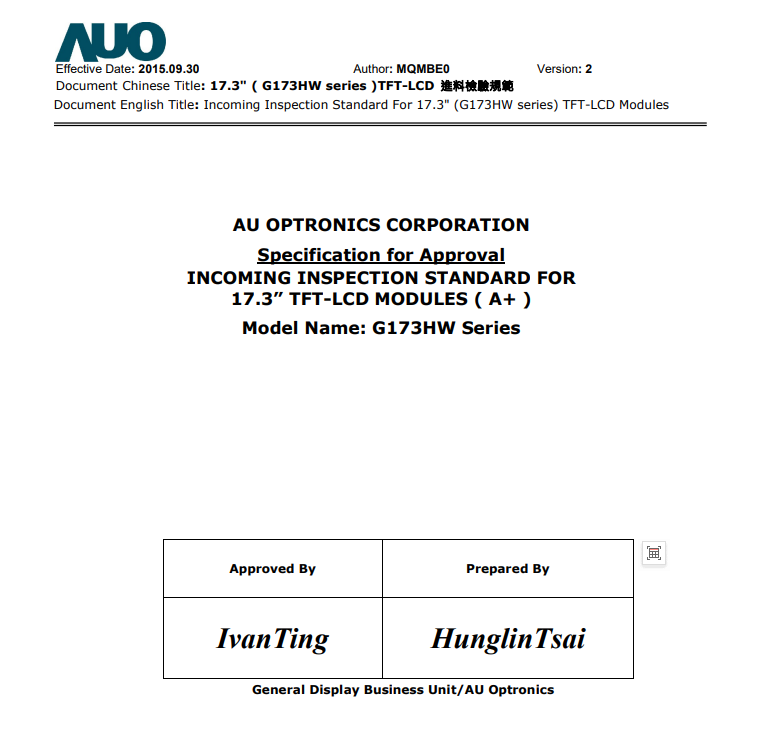
AU Optronics 17.3-inch G173HW series LCD module A+specification standard

AU Optronics 17 3-inch G173HW series LCD module A+specification standardAnalysis of the Incoming Inspection Standards
AU Optronics 17.3-inch G173HW series LCD module A+specification standard
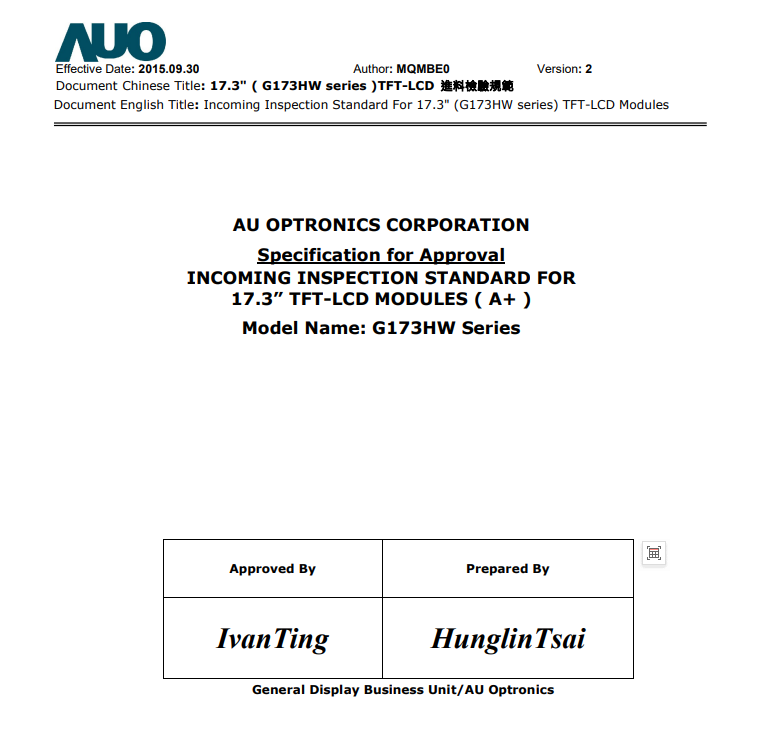
Analysis of the Incoming Inspection Standards for AU Optronics 17.3-inch G173HW Series LCD Modules
In the supply chain management of LCD display modules, Incoming Quality Control (IQC) is the first checkpoint to ensure the quality of end products. AU Optronics (AUO), as a leading global supplier of TFT-LCD, has developed detailed Incoming Inspection Standards for its 17.3-inch G173HW series modules. This specification not only clarifies the rights and responsibilities of both buyers and sellers in quality acceptance, but also provides a solid guarantee for the consistency of display panel quality through quantitative indicators and standardized inspection processes. This article is based on the latest version of the series of specifications (Rev. 2, released on September 30, 2015), and systematically summarizes its core content and technical points.
1. Scope of Inspection and Definition of Responsibilities
The specification first defines the scope of application: applicable to all 17.3-inch TFT-LCD modules (hereinafter referred to as "modules") supplied by AU Optronics. The inspection covers three main parts: electrical performance, appearance, and external dimensions.
In terms of responsibility and timeliness, the buyer shall complete the inspection within 20 calendar days after delivery, and bear the cost at their own expense. The inspection results must be recorded in writing and copied to the seller. If unacceptable defects are found in the entire batch of products during the inspection period, the buyer shall notify the seller in writing within three working days after the end of the inspection period; Failure to notify within the deadline shall be deemed as acceptance of the batch of products by default. This clause strengthens the timeliness of inspection and avoids long-standing quality disputes.
2.Sampling method: based on MIL-STD-105E standard
The specification clearly adopts the US military standard MIL-STD-105E as the sampling basis, with the following specific parameters:
Batch definition: Each model and shipment batch are considered as one inspection batch.
Sampling type: normal inspection, one-time sampling.
Inspection level: Level II (General Industrial Level).
Acceptable Quality Level (AQL): 1.0% for major defects and 2.5% for minor defects.
The standard also provides a sample code table (Table 14-1), which determines the corresponding sample size based on the batch size, and is accompanied by a judgment flowchart (Fig.2) to enable inspectors to quickly perform sampling and judgment.
3. Testing environment and instrument requirements
In order to ensure the repeatability and comparability of inspection results, strict regulations have been made for the inspection environment in the standard:
Parameter | Requirement |
Temperature | 20 ~ 25 ℃ |
Humidity | 65% ± 5% RH |
Illuminance | 300~700 lux under fluorescent lamp (standard 500 lux) |
Observation distance | 35 ± 5 cm from the surface of the module, with the line of sight perpendicular to the screen |
Observation method | Remove the protective film of the polarizer and visually judge it with the human eye |
The inspection instruments include signal generators (such as LD-2000), AU dedicated video boards, and luminance colorimeters (such as Topcon BM-7). These conditions ensure the standardization of inspection, making the results of different batches and inspectors comparable.
4. Defect classification: major defects and minor defects
The standard categorizes defects into two main types:
Major Defect: A defect that may cause the product to fail or significantly reduce its intended use.
Minor Defect: A deviation that has little impact on the expected use of the product or has little impact on effective use.
This classification directly corresponds to the different tolerances of AQL and guides inspectors to reasonably distinguish the severity of defects when making judgments.
5. Electrical Inspection Specification: Pixel Defects and Residual Images
Electrical performance is the core quality indicator of LCD modules. The G173HW series has very strict requirements for pixel defects (point defects):
Inspection Item | Specification requirements |
line defect | Not allowed to be visible |
highlight | 0个 |
Dark spot | ≤3 |
Total point defects | ≤3个 |
Two consecutive bright spots (vertical/horizontal/diagonal) | not allowed |
Three or more consecutive highlights | not allowed |
Two consecutive dark spots | Allow 1 pair |
Three or more consecutive dark spots | not allowed |
Bright and dark spots are adjacent | not allowed |
Distance between two bright spots | not allowed |
Distance between two dark spots | ≥15 mm |
Mura (uneven) | Not obvious under 6% ND filter |
Definition of Subpixels and "Small Highlights"
The specification specifically states that a sub-pixel is defined as a point. The defect area must be greater than or equal to 1/2 of the sub-pixel area to be counted as a point defect; Smaller bright spots are considered as "Small Bright Dots", with a maximum of 10 allowed. The judgment method is to use a 5% ND filter (30 cm away) for observation. If it can be seen, it is considered a bright spot, otherwise it is considered a small bright spot.
Check the graphics
The standard inspection pattern includes four types: black, red, green, and blue, which are used to detect bright or dark spots respectively. This helps to comprehensively evaluate the pixel performance under different color displays.
Image Retention Requirements
In Rev. 2 version, a criterion for determining residual images has been added: after using the test pattern, residual images must disappear within 5 seconds. This is an important supplement to dynamic display performance, especially suitable for applications such as laptops that frequently switch screens.
6. Appearance Inspection Specification
Appearance defects include particles, scratches, bubbles, dirt, as well as frame deformation, abnormal labels, loose screws, connector appearance, etc. within the active area. The standard provides the allowable quantities corresponding to different size ranges in the form of a table.
Foreign objects/particles (circular) in the active area
Average diameter D (mm) | Allowable quantity |
D < 0.4 | Negligible |
0.4 ≤ D < 0.6 | ≤ 10 pieces |
D ≥ 0.6 | 0 of them |
Linear defects (scratches/dirt)
Width W (mm) | Length L (mm) | Allowable quantity |
W ≤ 0.05 | L ≤ 2 | negligible |
0.05 < W ≤ 0.07 | 2 < L ≤ 5 | ≤ 3 items |
W > 0.07 | L > 5 | 0 items |
Bubble (circular)
Judging by diameter and quantity, the standard is similar to that of particles.
Borders and Labels
Border gap: The gap between the front and rear borders is allowed to be ≤ 0.8 mm; scratches, dents, and other harmful damage to the borders are not allowed.
Tags: No tags, content errors, positional offsets, wrinkles, or overlaps are allowed. If the stain does not exceed 30 mm x 20 mm and can still read words and scan barcodes, it is considered acceptable.
Screw: No missing or loose parts are allowed.
Connector: No damage, warping, or deformation is allowed.
Special Judgment Rules
When L ≥ 2W, defects are counted as linear defects.
The average diameter of the foreign object is D=half (W+L).
Wipable foreign objects (such as fingerprints and floating dust) are not considered defects.
Defects in the black matrix area (within 0.3 mm outside the active area) will not be considered.
Instructions for using ND filter: Place the filter about 10mm in front of the panel and observe it in front for 1 second at a distance of 35 ± 5 cm.
7. Inspection and determination, as well as handling of non conformities
According to the normal inspection sampling plan of MIL-STD-105E:
If the number of defects in the sample is ≤ the acceptable number, the batch is judged to be qualified.
If the number of defects is greater than or equal to the number of rejections, the batch shall be deemed rejected.
The buyer shall notify the seller in writing of the rejection result.
This process ensures the clarity and traceability of the judgment results, facilitating subsequent negotiation and handling between both parties.
8. Precautions for use: Key points to extend the lifespan of the module
The specification finally lists 19 usage precautions, covering mechanical stress, heat dissipation, dust prevention, power timing, electrostatic protection, backlight high-voltage safety, storage environment, etc. Of particular note are:
Avoid displaying static images for long periods of time (except for white) to prevent image sticking.
Power timing: Be sure to turn off the power before connecting or disconnecting the circuit.
Anti static: Do not touch the module on ungrounded equipment.
Anti condensation: Sudden temperature changes may cause damage to the polarizer.
High voltage safety: The backlight high-voltage area cannot be directly touched.
Mechanical protection: Avoid vibration, impact, or front/back compression, as this may result in uneven display or abnormal functionality.
These suggestions have important reference value for both machine manufacturers and end users, helping to reduce the risk of failure caused by improper use.
Conclusion
The A+specification inspection standard for the 17.3-inch LCD module of the AU Optronics G173HW series is a rigorous, comprehensive, and highly operable technical document. It not only ensures the consistency of product quality through quantitative electrical and appearance judgment criteria, but also provides a fair and transparent acceptance basis for both buyers and sellers through MIL-STD-105E sampling method and standardized inspection environment. For quality engineers, procurement personnel, and end product developers in the display industry, a deep understanding and strict implementation of such standards is a key step in ensuring product display performance and reducing supply chain quality risks. With the continuous advancement of display technology, such specifications will continue to iterate, setting a benchmark for quality control of high-end LCD modules.