Comprehensive Analysis of AU Focus on Star Sizes: 10.1-inch and 15.6-inch Series

10 1 inches and 15 6 inches are the two most core industrial display sizes These two sizes combine moderate physical size, rich resolution, and a wide range of application scenarios, and dominate fields such as human-machine interface (HMI),
Comprehensive Analysis of AU Focus on Star Sizes: 10.1-inch and 15.6-inch Series Details
In the 2026 product roadmap of AUO Display Plus, 10.1 inches and 15.6 inches are the two most core industrial display sizes. These two sizes combine moderate physical size, rich resolution options, and a wide range of application scenarios, occupying dominant positions in fields such as human-machine interface (HMI), portable devices, industrial tablets, medical terminals, self-service kiosks, etc. This article will provide a detailed analysis of the specifications, technical features, application positioning, and future development of the 10.1-inch and 15.6-inch series based on official data from the roadmap.
1. 10.1-inch series: the backbone of industrial widescreens
10.1-inch widescreen (usually 16:10 or 16:9) is the "golden size" in the industrial display field, which can provide sufficient information display area without being too large, suitable for integration into control panels, medical carts, smart home terminals and other devices. AU offers multiple 10.1-inch product lines, covering different resolutions, brightness, touch integration, and reliability levels.
1.1 Main models and technical parameters
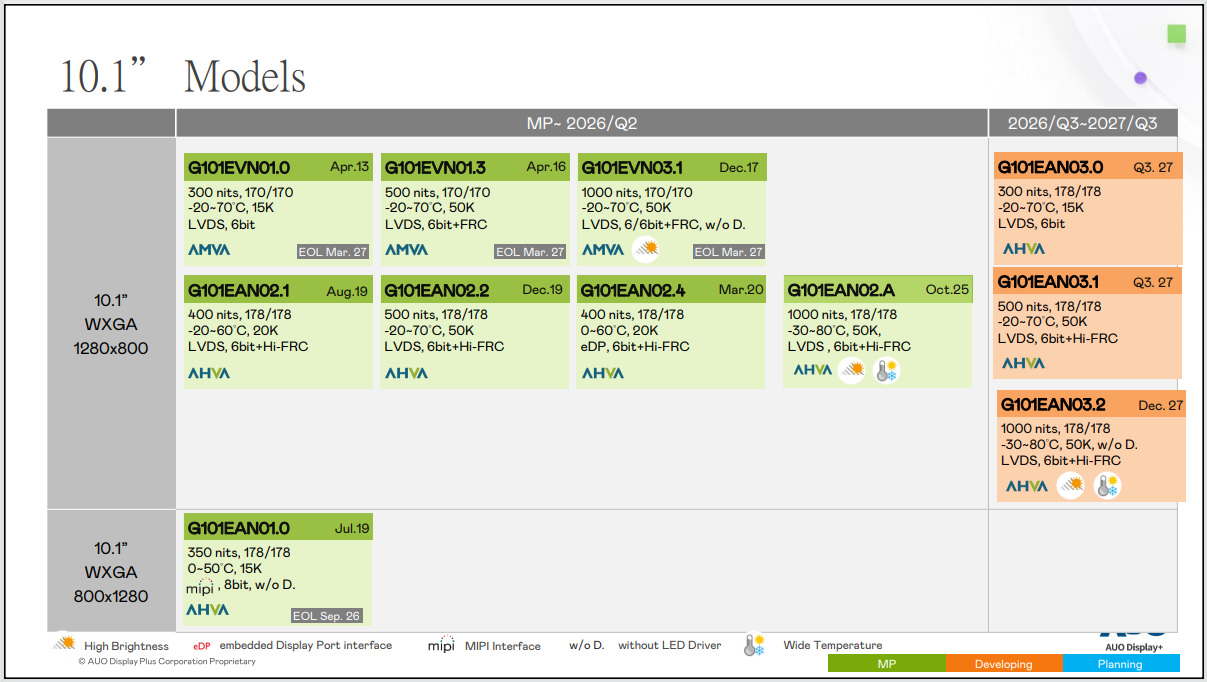
According to page 19 (widescreen product line), pages 30-32 (10.1-inch dedicated page), and page 57 (total solution P-Cap) of the 2026 Q2 Roadmap of AU, the summary is as follows:
Model | Resolution | Technology | Brightness (nits) | Operating Temperature | Backlight life | Interface | Special characteristics |
WXGA (1280×800) | AHVA/AMVA | 400~440 | -20~70℃ | 50K | LVDS | Standard industrial grade, with incoming inspection specifications in place | |
WXGA (1280×800) | AHVA | 400 | -20~70℃ | 50K | LVDS | Upcoming EOL (March 2027) | |
G101EAT02.6 | WXGA (1280×800) | AHVA | 400 | -20~70℃ | 50K | LVDS | With P-Cap touch, Air Bond, In mass production |
G101EVT05.1 | WXGA (1280×800) | AHVA | 440 | -20~70℃ | 50K | LVDS | Touch enabled, SOL (EOL) discontinued in March 2021 |
G101EAT04.0 | WXGA (1280×800) | AHVA | 440 | -20~70℃ | 50K | LVDS | Equipped with P-Cap, planned for mass production in Q2 2027 |
G101EAN03.0/03.1/03.2 | (Expected WXGA or HD) | AHVA | to be determined | -20~70℃ | 50K | LVDS/eDP | Planned mass production from Q3 to December 2027 to replace the old model |
Additionally: 10.1 "HD (1366 × 768) | AHVA | be unknown | -20~70℃ | 50K | LVDS | Listed in the widescreen product line, specific models not listed |
As can be seen from the table:
The main models: G101EAN series (non touch) and G101EAT series (with P-Cap touch) are currently the main push. G101EAT02.6 will be mass-produced in August 2023 and is still actively supplied.
Transition and discontinuation: G101EVN01. x will be EOL in March 2027, and G101EVT05.1 has been discontinued in 2021 (SOL). Suggest turning the new design to G101EAN03. x or G101EAT04.0.
New model planning: G101EAN03.0/03.1/03.2 are scheduled for mass production in Q3, Q3, and December 2027, respectively. Although the resolution has not been announced, according to naming conventions, it should be an upgraded version of the same size, which may support higher brightness or narrower borders.
1.2 Typical applications of 10.1 inches
Industrial HMI: such as PLC programming terminals and factory production line dashboards. The WXGA (1280 × 800) resolution is sufficient to display complex graphical interfaces, and the 400 nits brightness is clear and readable in indoor environments.
Medical Cart: With P-Cap touch, medical staff can still operate it even with gloves on; Wide temperature range (-20~70 ℃) to adapt to different departmental environments in the hospital.
Intelligent retail: self-service ordering machines, secondary screens at checkout counters. The overall solution with touch simplifies system integration.
In car infotainment: Some wide temperature models can be used for special vehicles.
2. 15.6-inch series: responsible for traffic in large screen industrial applications
15.6 inches is currently one of the largest shipped sizes in industrial widescreens, which combines portability (suitable for 15.6 inch industrial tablets) and rich display content. It is commonly used in high-end HMI, medical imaging workstations, industrial all-in-one machines, self-service ticket vending machines, etc. AU has laid out the most models on the 15.6-inch screen, covering a complete product matrix from HD to FHD, TN to AHVA, and from standard brightness to high brightness wide temperature.
2.1 Main models and technical parameters
According to the roadmap on page 20 (widescreen product line, 15.6 "section), pages 41-44 (15.6-inch dedicated page), and page 58 (oTP model), the summary is as follows:
Model | Resolution | Technology | Brightness (nits) | Operating Temperature | Backlight life | Interface | special characteristics |
FHD (1920×1080) | AHVA | 300~500 | 0~50℃ / -20~70℃ | 50K | LVDS/eDP | Standard main force | |
G156HAB05.x | FHD (1920×1080) | AHVA | 300~500 | 0~50℃ | 50K | eDP | Mass production in April 2026, ultra-thin/narrow bezel |
A156HAN01.4 | FHD (1920×1080) | AHVA | 400 | -20~70℃ | 50K | LVDS | Mass production in June 2026, wide temperature range |
A156HAN01.5 | FHD (1920×1080)) | AHVA | 500 | -20~70℃ | 50K | LVDS | Mass production in June 2026, high brightness |
G156XTN Series | HD (1366×768) | TN | 300 | 0~50℃ | 30K | LVDS | Low cost version |
G156WXGA Series | WXGA (1280×800) | AHVA | 300~400 | -20~70℃ | 50K | LVDS | 16:10 Proportion |
Model with touch assembly | FHD/HD | AHVA/TN | 250~400 | 0~50℃ | 30K~50K | LVDS+USB | oTP Or P-Cap |
List several key models in detail (based on data from pages 41-44 of the ROADMAP document for AUO Q2 2026):
G156HAN01.0 (assuming similar numbering exists): In actual documents, there are multiple 15.6 "FHD AHVA models with a brightness of 300-500 nits and a typical operating temperature of 0-50 ℃. Some wide temperature models have been extended to -20~70 ℃.
A156HAN01.4: MP June 2026, brightness 400 nits, -20~70 ℃, LVDS,8bit,AHVA。
A156HAN01.5: MP June 2026, brightness 500 nits, -20~70 ℃, LVDS,8bit,AHVA, Suitable for semi outdoor use.
G156HAB05.x MP April 2026, eDP interface, emphasizing the "Flat Type" ultra-thin design, suitable for thin and light industrial tablets.
Low cost TN models: such as G156XTN01.0 (assumed), HD resolution, brightness of 300 nits, 0-50 ℃, 30K backlight life, suitable for budget sensitive projects.
2.2 15.6-inch technology trend
FHD has become the absolute mainstream: except for extremely low-cost applications, almost all newly planned 15.6-inch models adopt a 1920 × 1080 resolution with a pixel density of about 141 PPI, which is very delicate at normal viewing distances.
AHVA is widely adopted: In the early days, there were still a large number of TN and AMVA models for 15.6 inches, but in 2026, new models such as A156HAN01.4/1.5 and G156HAB05. x will all use AHVA, providing a wide viewing angle and low color cast.
Coexistence of wide temperature and high brightness: Traditional industrial tablets are mostly used indoors, but with the increasing demand for outdoor self-service terminals, models with a brightness of 500 nits and a working temperature of -20~70 ℃ are becoming increasingly important.
Interface evolution towards eDP: Although LVDS is still mainstream, new models such as G156HAB05. x adopt eDP, supporting higher refresh rates and fewer pins, which is in line with the trend of the PC industry.
3. Comparison of application scenarios: 10.1 inches vs 15.6 inches
Dimension | 10.1 inch | 15.6 inch |
Physical dimensions | About 230×150 mm | About 360×230 mm |
Typical Resolution | WXGA (1280×800) | FHD (1920×1080) |
Pixel density | 149 PPI | 141 PPI |
Suitable for equipment | Handheld terminal, small HMI, medical cart | Industrial tablets, medical workstations, self-service vending machines |
Touch integration | Very common (P-Cap) | Universal (P-Cap and oTP) |
outdoor applications | Less (small size, brightness can reach 500+) | More (need to highlight models such as 500 nits) |
Cost level | Medium | Medium (slightly above 10.1 ") |
4. Touch integration and overall solution
For these two star sizes, AU offers a wide range of Total Solution Models, including pre integrated modules for LCD and touch screens (mostly P-Cap), to simplify customer procurement and assembly.
4.1 10.1-inch touch model
G101EAT02.6: Current main force P-Cap, AHVA, 400 nits, Air Bond, In mass production.
G101EAT04.0: Planned for mass production in Q2 2027, with brightness increased to 440 nits, AHVA,Air Bond。
The previous generation G101EVT05.1 has been discontinued (SOL March 2021), and it is not recommended to adopt a new design.
4.2 15.6-inch touch model
On page 58 of the document, "14"/15 "/15.6" oTP Models "are listed. oTP (On cell Touch Panel) integrates touch sensors directly onto the LCD panel, which is thinner than traditional P-Cap. The specific models have not been listed one by one, but it can be expected that:
The 15.6-inch oTP model adopts AHVA+FHD, supports 10 point touch, and is matched with cover glass, suitable for high-end industrial tablets.
In addition, AU also offers 15.6-inch P-Cap assemblies (such as the G156HAT series, not detailed in the roadmap), which can be obtained through sales representatives.
5. Future planning and shutdown transition
5.1 10.1 inch future
New models: G101EAN03.0 (Q3 2027), G101EAN03.1 (Q3 2027), G101EAN03.2 (December 2027). These models are expected to improve in optical performance or mechanical design, such as further narrowing the bezels, increasing brightness to 500 nits, or adding eDP interfaces.
Discontinuation transition: G101EVN01.0 and G101EVN01.3 will be EOL in March 2027, with LTB orders ending in September 2026. If these old models are currently being used, it is recommended to complete the verification switch to G101EAN03. x or G101EAT04.0 within 2026.
5.2 15.6-inch Future
New models: A156HAN01.4 and A156HAN01.5 will both be mass-produced in June 2026, providing 400/500 nits brightness and wide temperature support, making them the most recommended new design choices at present.
Ultra thin model: G156HAB05. x will be mass-produced in April 2026, focusing on eDP and thinning, suitable for embedded systems with thickness requirements.
Discontinuation information: The document does not explicitly list the EOL of the 15.6-inch old model, but it can be expected that the old TN or early AHVA versions will gradually be phased out with the mass production of the new model. It is recommended to prioritize the use of models produced in 2026 and beyond in the design to ensure a longer lifespan.
6. Summary of Selection Suggestions
Demand scenario | Recommended 10.1-inch model | Recommended 15.6-inch model |
Indoor HMI, no touch required | G101EAN series (existing or 03. x) | G156HAN01. x (standard brightness 300~400) |
Indoor HMI requires P-Cap touch | G101EAT02.6 (ready-made) or G101EAT04.0 (future) | Choose oTP or P-Cap assembly, such as G156HAT series |
Semi outdoor, requiring high brightness | Customizable high brightness backlight, or waiting for 03. x high brightness version | A156HAN01.5(500nits) |
Wide temperature environment (-20~70 ℃) | G101EAN/EAT series (all support -20~70 ℃) | A156HAN01.4/1.5 (explicitly supports -20~70 ℃) |
Ultra thin design, eDP interface | Not yet clear, please consult | G156HAB05.x(eDP,Flat Type) |
Cost sensitive, low resolution | Not recommended to use low scores (HD available but few) for 10.1 | G156XTN01.x(HD,TN) |
Conclusion
10.1 inches and 15.6 inches are the two star sizes of the AU Display Plus industrial LCM product line, covering a wide range of industrial applications from entry-level to high-end, indoor to semi outdoor, with rich resolution options, advanced AHVA wide viewing angle technology, wide temperature high brightness reliability, and flexible touch integration solutions. In the 2026 roadmap, both dimensions have clear new model plans (G101EAN03. x, A156HAN01. 4/1.5, G156HAB05. x), while the EOL transition of the old models also provides customers with sufficient time window. For system integrators and equipment manufacturers, a deep understanding of the product lineages of these two series will help make future oriented display selection decisions and ensure long-term supply stability for projects.
AUO 10.1-inch LCD screen:https://www.idtdisplay.com/products/AUO_LCD_Displays/10-1inch
AU 15.6-inch LCD screen:https://www.auo-lcd.com/products/auo-lcd-screen/15_6inch/