AU Optronics Industrial Quality: Long Life, High Brightness, and Wide Temperatur

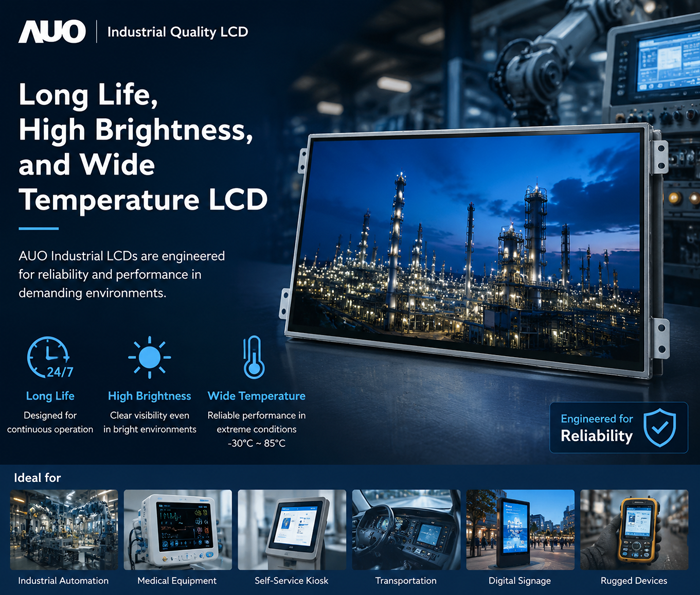
AU Optronics regards "industrial grade quality " as its core competitiveness and supports this position through four pillars: longevity, high brightness, wide temperature liquid crystal, and reliability testing
AUO Industrial Quality: Long Life, High Brightness, and Wide Temperature LCD
Comprehensive analysis of industrial grade quality of AU Optronics: long lifespan, high brightness, and wide temperature LCD
In fields such as industrial automation, outdoor self-service terminals, medical imaging, transportation, and smart cities, the working environment faced by display modules is far more demanding than that of ordinary consumer electronics products. Challenges such as high temperature, low temperature, direct sunlight, long-term continuous operation, and vibration impact all require industrial grade display screens to have reliability far beyond ordinary products. In its Q2 2026 product roadmap, AUO Display Plus explicitly identifies "industrial grade quality" as its core competitiveness and supports this positioning through four pillars: longevity, high brightness, wide temperature liquid crystal, and reliability testing. This article will comprehensively analyze the key characteristics of industrial grade display panels based on the specific models and technical descriptions in the 2026 Q2 Roadmap of AU Optronics.
1. Long lifespan: not only LED backlight, but also full cycle supply guarantee
1.1 Backlight lifespan: Starting from 50K hours, up to 70K hours
For industrial equipment, the backlight lifespan of display modules directly determines the effective service life of the product. AU's industrial grade LCD modules commonly use high reliability LED backlighting, with a standard lifespan of 50000 hours (based on a threshold of 50% brightness attenuation). Calculated by running continuously for 24 hours a day, 50K hours is equivalent to about 5.7 years; If the device runs for 12 hours a day, it can be used for more than 11 years.
In some high-end models, the backlight lifespan has been further extended to 70000 hours. For example:
G065VN01V2 (6.5-inch VGA, AHVA): Brightness of 800 nits, operating temperature of -30~80 ℃, backlight life of 70K hours.
G084SAN01.0 (8.4-inch SVGA, AHVA): Brightness of 450 nits, operating temperature of -30~85 ℃, backlight life of 70K hours.
In addition, AU also offers replaceable light bar designs, such as the 17 inch G170EG01 V104 model, which allows for on-site replacement of LED light bars after the backlight life has ended, further extending the overall service life of the module and reducing long-term maintenance costs for customers.
1.2 Product lifecycle: At least 3 years of supply guarantee
The biggest concern for industrial customers is not the physical lifespan of individual panels, but the sudden discontinuation of the model leading to the re certification of the entire machine. AU has made a clear commitment to provide a product lifecycle of at least 3 years from mass production shipment (MP). And when the product is phased out (EOL), a notice of discontinuation should be issued at least one year in advance, while ensuring the compatibility of new and old products in mechanical and electrical interfaces (ME/EE interface compatibility), thus achieving a smooth transition. This strategy is clearly stated on pages 15 and 67 of the document.
2. High brightness: Conquer strong light environments from 300 nits to 1500 nits
2.1 Brightness Grading and Application Scenarios
The brightness of ordinary consumer grade displays is usually between 250~350 nits, which is sufficient in indoor environments, but once placed in storefronts near windows, semi outdoor sunshades, or completely outdoor environments, the image will become difficult to recognize. AU industrial grade products offer multiple brightness levels:
Brightness range | Typical application scenarios | Representative model |
300~500nits | Indoor industrial control HMI、 medical diagnosis | G116HANO1.0 (300 nits), G101EAT02.6 (400 nits) |
500~800nits | High ambient light indoor, semi outdoor | G035QTN07.0 (500 nits), G213UAN01.0 (500 nits) |
1000~1500nits | Outdoor direct sunlight | G213UAN01.1X (1000 nits), G240HVNO1.0 (1500nits) |
Among them, G240HVN01.0 is one of the models with the highest brightness in the route map, a 24 inch FHD, using AMVA technology, with a brightness of up to 1500 nits and a working temperature of -30~80 ℃. It is specially designed for extreme strong light environments such as outdoor gas station billboards and bus station information screens.
2.2 High brightness and heat dissipation design
It should be pointed out that high brightness means higher LED driving current and more heat generation. AU has implemented multiple thermal management measures in its high brightness models, including the use of low thermal resistance backplate materials, optimized LED bead arrangement, and support for external heat sinks in some models. At the same time, the working temperature range of high brightness models is often wider (such as -30~80 ℃), ensuring that the brightness will not be reduced or the LCD will not be damaged due to overheating under direct sunlight in summer.
3. Wide temperature LCD: Breaking through the consumer level shackles of 0-50 ℃
Why do we need a wide temperature LCD?
The operating temperature of ordinary consumer grade LCDs is usually limited to 0-50 ℃. When the ambient temperature is below 0 ℃, the activity of liquid crystal molecules decreases, the response speed slows down sharply, and even "freezing" or "black spots" phenomenon occurs (i.e. the liquid crystal cannot deflect normally). When the temperature exceeds 50 ℃, the liquid crystal may undergo irreversible phase transition, resulting in permanent damage to the display.
In industrial scenarios, equipment may be installed outdoors in winter in the north (-30 ℃) or in cabinets exposed to sunlight in summer in the south (over 70 ℃). Therefore, wide temperature LCD has become an essential feature of industrial grade panels.
3.2 Temperature Range of AU Wide Temperature Products
According to the roadmap, AU's wide temperature products cover three levels:
Standard wide temperature range: -20 ℃~70 ℃ (e.g. 10.1-inch G101EAT02.6, 3.5-inch A035QTN07.0)
Extended wide temperature range: -30 ℃~80 ℃ (e.g. 6.5-inch G065VN01V2, 8.4-inch G084SAN01.0, 24 inch G240HVN01.0)
Extreme wide temperature range: -30 ℃~85 ℃ (e.g. 8.4-inch G084SAN01.0, 17 inch G170EG01 V104)
Among them, G084SAN01.0 achieves a working temperature of -30~85 ℃ and a backlight life of 70K hours, which is a model of industrial grade quality.
3.3 Technology for preventing low-temperature black spots
On page 14 of the roadmap, AU specifically mentions the "Wide strength Liquid Crystal" technology, which is based on the use of specially formulated liquid crystal materials that can maintain sufficient rotational viscosity at low temperatures to prevent the occurrence of "black spots". This black spot phenomenon is common in some consumer grade display screens that display static images for a long time at low temperatures, and due to ion contamination or degradation of the liquid crystal orientation layer, local deflection cannot be normal. By optimizing the purity of the liquid crystal material, the alignment layer material, and the driving waveform, AU ensures that the product can still start and display normally in an environment of -30 ℃.
4. Reliability testing: 300 hours of verification to ensure fault free operation
Industrial grade products cannot rely solely on design parameters and must undergo strict reliability verification. AU performs at least 300 hours of reliability testing on each industrial grade module, typically including:
High temperature and high humidity operation: 60 ℃/90% RH, lasting for 240-300 hours, to test moisture resistance.
High temperature storage: Dry environment at 85 ℃ for 300 hours, testing for material thermal aging.
Low temperature storage: -40 ℃, 300 hours, test the cold resistance of LCD and backlight.
Temperature cycle: -40 ℃ ↔ 85 ℃, every 3 hours for a total of 100 cycles, to test the structural resistance to thermal expansion and contraction.
Vibration and impact: Simulate mechanical stress during transportation and use.
Only products that have passed 300 hours of testing are allowed to be labeled as "industrial grade" and enter AU's mass production list. The "Reliable 300hs Reliability Test" icon is clearly listed on page 14 of the document, proving that AU regards this as a standard process rather than an optional item.
5. Comprehensive Case: From Parameters to Practical Applications
In order to gain a more intuitive understanding of how these industrial grade features work together, we have selected two typical models for analysis:
Case 1: G065VN01 V220 (6.5 inches, AHVA)
Brightness: 800 nits → suitable for semi outdoor or near window devices.
Working temperature: -30~80 ℃ → Can work stably at outdoor charging stations in cold winter or in factory workshops in hot summer.
Backlight lifespan: 70K hours → If operated 24 hours a day, it can last for 8 years.
Reliability: Passed 300 hour test → Even if frequently turned on or off or subjected to temperature changes, Mura or black spots will not easily appear.
Applicable scenarios: outdoor charging station display screens, heavy-duty machinery cab instruments, ship navigation.
Case 2: G240HVN01.0 (24 inches, AMVA)
Brightness: 1500 nits → Clear and readable even under direct sunlight at noon.
Working temperature: -30~80 ℃ → Suitable for desert environments ranging from winter in Northeast China to summer in the Middle East.
Backlight lifespan: 50K hours → 12 hours of daily operation, usable for over 11 years.
Technology: AMVA (3000:1 contrast ratio) → Deep black color to improve readability under strong light.
Applicable scenarios: outdoor digital signage, bus stop information screens, gas station billboards.
6. Summary: Multidimensional guarantee of industrial grade quality
The industrial grade quality of the AU Display Plus is not highlighted by a single parameter, but is built through four dimensions: long lifespan (50K~70K hours backlight+at least 3 years product life cycle), high brightness (up to 1500 nits), wide temperature LCD (minimum -30 ℃~maximum 85 ℃), and rigorous 300 hour reliability testing. For end users, this means lower replacement frequency, wider deployment area, stronger environmental adaptability, and lower total cost of ownership (TCO).
In its product roadmap for Q2 2026, AU is expanding this industrial grade gene to more sizes and resolutions - from 6.5 inches to 27 inches, from VGA to UHD. Whether it's the northern transportation system that requires a -30 ℃ cold start, or the outdoor advertising screens that require clear display under direct sunlight in the desert, AU has provided validated and mass-produced solutions. This is precisely the core value of a globally leading general display supplier.