AU Optronics offers multiple LCD technologies: TN, MVA, PSA, and AHVA

As a leading global supplier of TFT-LCD modules, AU Optronics,AU currently promotes four core LCD technologies: TN, MVA, PSA (AMVA3), and AHVA
Comprehensive analysis of multiple LCD technologies from AU Optronics: TN, MVA, PSA, and AHVA
In the fields of industrial displays, medical imaging, public displays, and high-end consumer electronics, the display performance of LCD panels directly affects the user experience and reliability of terminal devices. As a leading global supplier of TFT-LCD modules, AU Optronics (AUO) and its subsidiary AUO Display Plus have long been committed to the research and industrialization of various LCD technologies. According to the product roadmap released in the second quarter of 2026, AU currently promotes four core LCD technologies: TN, MVA, PSA (AMVA3), and AHVA. This article will provide an in-depth analysis of the characteristics, performance differences, and typical application scenarios of these four technologies based on the official technical parameters and product layout of AU Optronics' Q2 Roadmap in 2026.
1. Technical Overview: Four Routes with Each Focus
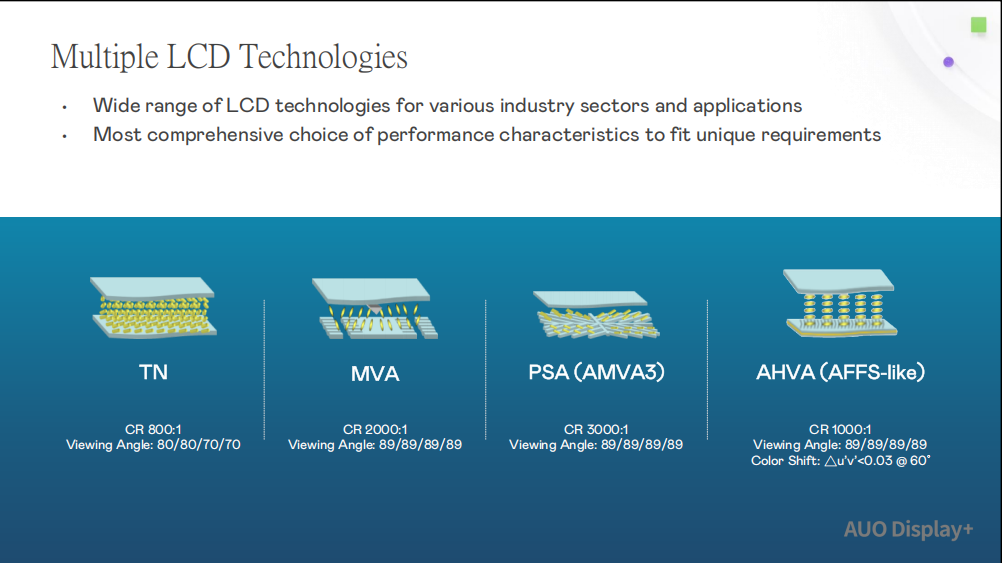
AU's LCD technology matrix covers a wide range of needs from cost sensitive to professional grade high-definition displays. The following table summarizes the key performance indicators clearly listed in the roadmap:
Technical Type | Contrast | Perspective (typical value) | Color cast control | Main advantages |
TN | 800:1 | 80/80/70/70 | unspecified | Fast response and low cost |
MVA | 2000:1 | 89/89/89/89 | unspecified | High contrast, wide viewing angle |
PSA (AMVA3) | 3000:1 | 89/89/89/89 | unspecified | Ultra high contrast and excellent dark field performance |
AHVA | 1000:1 | 89/89/89/89 | Δu'v'<0.03 @60° | Accurate color and excellent consistency in viewing angle |
It should be noted that AHVA (Advanced Hyper Viewing Angle) is a wide viewing angle technology independently developed by AU. Its optical properties are similar to IPS (AFFS like), but have been specially optimized for color cast control.
2. TN: Classic choice, economical and efficient
TN (Twisted Nematic) is one of the most mature and widely used technologies in the field of liquid crystal displays. In the AU roadmap, the typical contrast ratio for TN products is 800:1, with a viewing angle of 80 ° (horizontal)/80 ° (horizontal)/70 ° (top)/70 ° (bottom). Although the perspective is not as good as other technologies, TN has two irreplaceable advantages:
Fast response speed: The twisting response time of TN LCD can easily reach 5ms or even lower, suitable for displaying dynamic images and avoiding ghosting.
Low production cost: mature process, high yield, suitable for batch applications with strict cost requirements.
In AU's product line, TN technology is commonly found in small-sized or entry-level industrial display modules. For example, the 2.7-inch QVGA (A027DTN01. F) and 3.5-inch QVGA (A035QN02 VG) both use TN, with brightness ranging from 310~500 nits and operating temperature coverage of -20~70 ℃. They are mainly used in home appliance control panels, portable devices, simple human-machine interfaces, and other scenarios. In addition, some widescreen models such as 15.6-inch HD (1366 × 768) also offer TN versions to meet the needs of low-priced industrial tablets.
Applicable suggestion: If the project budget is tight, the perspective requirement is not high, and the working environment temperature range is moderate, TN is still a reliable choice.
3. MVA: High contrast wide-angle solution
MVA (Multi domain Vertical Alignment) technology achieves a wider viewing angle and higher native contrast than TN through the tilted arrangement of liquid crystal molecules in the multi domain region. The typical contrast ratio of MVA products provided by AU reaches 2000:1, with a viewing angle of 89 °/89 °/89 °/89 ° in all directions, and almost no grayscale reversal phenomenon.
Compared to TN, MVA's black performance is more pure, with rich dark field details, making it very suitable for applications that require clear images in darker environments, such as medical diagnostic displays, industrial monitoring terminals, etc. AU's MVA technology is also commonly used in some mid size modules, such as 8-inch WVGA (800 × 480) and some early 15 inch products.
However, it should be pointed out that MVA is gradually being replaced by PSA (AMVA3) and AHVA in AU's current roadmap. However, in some mature mass-produced models, MVA still occupies a place with stable performance and relatively moderate cost. For example, the 24 inch FHD (G240HVN01 series) adopts AMVA (i.e. advanced MVA), with a brightness of 300-1500 nits and a wide operating temperature range of -30~80 ℃, widely used in self-service terminals and industrial displays.
4. PSA (AMVA3): Ultimate Contrast and Dark Field Performance
PSA (Polymer Stabilized Alignment) is the third-generation AMVA technology upgraded from MVA by AU, marked as AMVA3 in the roadmap. The core breakthrough lies in further increasing the native contrast ratio to 3000:1 while maintaining an 89 ° full field of view.
Such a high contrast means that the black panel has almost no visible light leakage in a dark room environment, and the image layering is extremely prominent. For situations that require frequent display of dark backgrounds or imaging diagnosis (such as X-rays), PSA technology has significant advantages. In addition, the liquid crystal response speed of PSA has been improved compared to traditional MVA, reducing motion blur.
From the perspective of product layout, PSA technology is mainly applied to high-end industrial displays of medium to large-sized. For example, some FHD models of 21.5 inches and 27 inches use AMVA3, with brightness coverage of 300-1000 nits, and support operating temperatures of -20~70 ℃ or 0-50 ℃. Although the document does not directly list the specific model of PSA, according to the technical code, G240HVN02.0 (24 inch FHD, AMVA) is likely to have adopted a process close to PSA level.
Unique value: If the application scenario has strict requirements for black purity and dark details, and the budget allows, PSA is the optimal solution.
5. AHVA: Benchmark for Color Accuracy and Perspective Consistency
AHVA (Advanced Hyper Viewing Angle) is AU's core product line that benchmarks IPS technology. Its key parameters are: contrast ratio of 1000:1, full viewing angle of 89 °, and color cast Δ u'v '<0.03 at a viewing angle of 60 °. This color shift indicator means that the color shift is extremely small and almost imperceptible when viewed from different angles, which is crucial for professional fields where multiple users are watching simultaneously or precise color judgment is required.
AHVA technology is widely used in AU's mid to high end industrial display modules, especially in the following product directions:
High resolution models: such as 10.1-inch WXGA (1280 × 800), 15.6-inch FHD (1920 × 1080), 21.3-inch UXGA/QXGA (1600 × 1200 or 1536 × 2048), 27 inch UHD (3840 × 2160), etc.
Medical Display: The 21.3-inch G213UAN01.1X provides 1000 nits brightness, sRGB 100% color gamut, and adopts AHVA technology, designed specifically for medical imaging.
Wide color gamut and high refresh rate: The 27 inch UHD model G270ZAN02.3 supports DCI-P3 98% color gamut and 144Hz refresh rate, also using AHVA solution.
Touch integration: Multiple P-Cap total solution modules (such as 10.1-inch G101EAT02.6, 7-inch G070VAT01.0) are based on AHVA panels to ensure consistent display after touch.
Another major advantage of AHVA is its compatibility with modern interfaces. Many AHVA modules use LVDS, eDP, or V-by-One interfaces, supporting 8-bit or 10 bit color depth and capable of presenting over 16.7 million colors.
Applicable scenarios: medical imaging, professional drawing, high-end HMI, outdoor high brightness display (with high brightness backlight), etc.
6.Technology Selection Matrix: How to Match Suitable LCD Technologies for Projects
Based on AU's 2026 product roadmap, we can summarize the following selection recommendations:
Requirement priority | Recommended Technology | Typical model examples (from roadmap) |
Lowest cost, fast response, and low perspective requirements | TN | A027DTN01.F, A035QN02 VG |
High contrast, good viewing angle, moderate cost | MVA/AMVA | G240HVN01 V1, G240HVN01.0 |
Ultimate contrast, black has strong expressive power | PSA (AMVA3) | 24 "/27" model with AMVA3 logo |
Accurate color, consistent viewing angle, wide color gamut | AHVA | G213UAN01.1X, G270ZAN02.3, G101EAT02.6 |
Touch screen applications should avoid color cast | AHVA | G070VAT01.0, G238HAT01.x |
It is worth noting that AU is increasingly inclined to adopt AHVA and PSA technologies when planning new models. For example, the newly launched 10.4-inch SVGA (G104SAN01.0) and 14 inch FHD (A140HAN01.0) both use AHVA, and some sizes that used TN in the past are also being replaced by AHVA versions.
7. Future prospects: Technology integration and continuous innovation
From the roadmap, it can also be seen that AU is not satisfied with the existing technological division. For example, on the 27 inch UHD product line, AHVA has achieved a refresh rate of up to 144Hz, DCI-P3 98% color gamut, and 2000:1 dynamic contrast (assisted by local dimming technology). This shows that the potential of AHVA is far from fully tapped, and in the future, it is expected to further approach PSA's contrast level while maintaining its wide viewing angle and color advantages.
On the other hand, PSA technology is also seeking breakthroughs, such as combining Mini LED backlighting to achieve HDR effects. TN, on the other hand, is still irreplaceable in specific industrial scanning or instrumentation applications due to its ultra fast response speed.
Conclusion
AU Display Plus has built an LCD product matrix covering low, medium, and high performance ranges through four technologies: TN, MVA, PSA, and AHVA. Understanding the core parameters and positioning of each technology helps engineers and procurement personnel make correct panel selection decisions in the early stages of the project. Whether it's pursuing economic TN, emphasizing contrast PSA, or pursuing color and viewing angle consistency AHVA, AU has provided rich and mass-produced solutions in its 2026 product roadmap. In the future, with the continuous evolution of processes, the boundaries between these technologies may further blur, but what remains unchanged is AU's continued commitment to industrial grade reliability, long lifecycle, and display performance.