Tartan Native Mask Process: The Technical Foundation for Non standard Display

In the field of non-standard displays, "customized size " does not mean simple cutting Display modules with different proportions, brightness, and material combinations have put forward requirements for manufacturing processes that far exceed those
Tartan Native Mask Process: The Technical Foundation for Non standard Display
Tartan Native photomask process: redefining the technical boundaries of non-standard displays
In the field of non-standard displays, "customized size" does not mean simple cutting. Display modules with different proportions, brightness, and material combinations have put forward requirements for manufacturing processes that far exceed those of conventional screens. ADP Tartan Technology has truly achieved complete customization capabilities from mask design to module output through its independently developed Tartan Native mask process.
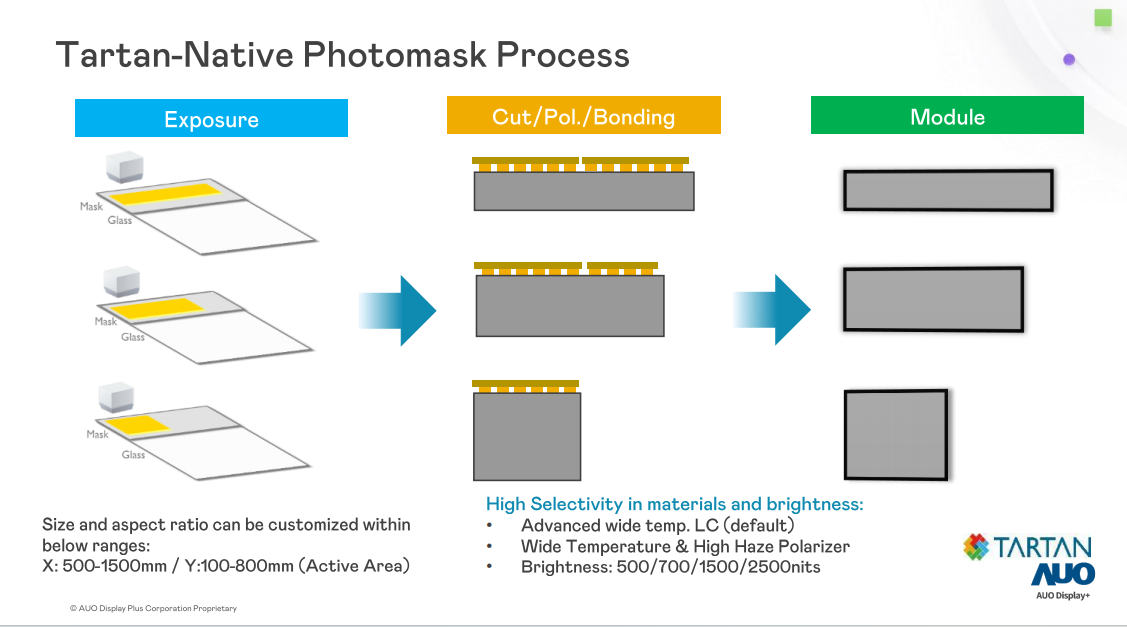
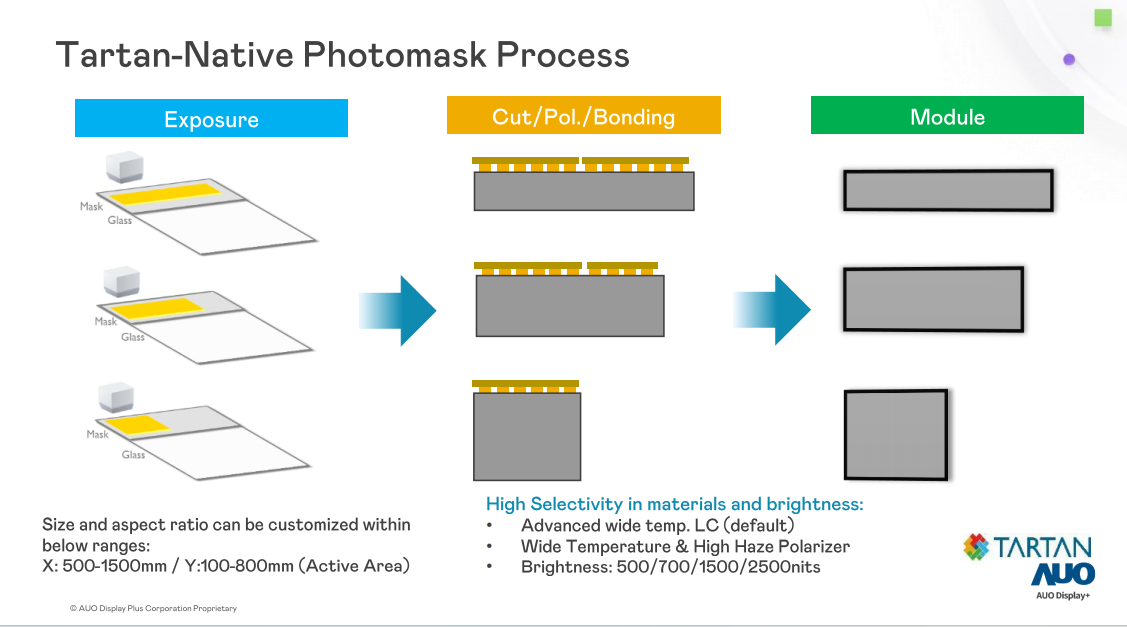
Three core processes: exposure → cutting/polishing → binding
The Tartan Native process is not a secondary processing of standard panels, but rather a native design for non-standard sizes from the photomask stage.
1. Exposure
Based on the customer specified active area, redesign the mask graphic to correspond display pixels one-to-one with irregular/non-standard contours. This step ensures that the arrangement density and optical performance of each sub-pixel remain uniform and consistent in non-standard forms.
2. Cutting and polishing
Using high-precision cutting technology to separate monomers and polishing the edges to avoid stress concentration or light leakage. Even irregular shapes such as arcs and trapezoids can maintain neat structural strength and display integrity.
3. Binding
Bind the customized glass substrate with driver IC, FPC and other components to complete the complete module packaging from optical to electrical. This step is particularly crucial for narrow border and narrow spacing design.
High selectivity: flexible combination of materials and brightness
The requirements for display screens vary greatly among different transportation applications - in car information screens require wide temperature reliability, while outdoor guide signs require ultra-high brightness. The Tartan Native process supports highly selective material combinations:
Wide temperature LCD (default): Suitable for harsh environments ranging from -30 ℃ to 85 ℃, ensuring response speed and contrast.
Wide temperature and high haze polarizing film: effectively reduces reflection and improves visibility in strong ambient light.
Multi level brightness options: 500/700/1500/2500 nits, covering scenes from semi indoor to direct sunlight.
This means that customers do not have to sacrifice optical performance for size customization, but can instead choose the most suitable combination of brightness and materials for their own scene like building blocks.
Flexible size range
The Tartan Native process supports free customization within the following effective display area range:
X direction: 500-1500 mm
Y direction: 100-800 mm
Whether it is a slender strip screen (such as a subway car information strip) or a nearly square information interaction screen, they can be implemented within a set of photomask systems without the need for additional development cycles.
Truly 'native non-standard'
Many manufacturers' non-standard solutions involve cutting and masking on standard panels, resulting in pixel waste, uneven brightness, or excessively wide borders. The Tartan Native photomask process is designed for the customer's target size and shape from the beginning of the photomask, so it can achieve:
· Pixel utilization rate approaching 100%
· Minimize border
· Brightness consistency is better than cutting scheme
· Conclusion
· ADP Tartan Technology is not just a company that provides non-standard display screens, but also a technology solution provider with the ability to design bottom level photomasks and combine flexible materials. The emergence of Tartan Native process has made traffic displays no longer "compromise" - whether it is size, brightness, or environmental adaptability, they can all be precisely designed.
· In the field of transportation applications with limited space, complex environments, and extremely high reliability requirements, Tartan Native is becoming the new standard for non-standard display technology.
AUO LCD DISPLAY:https://www.idtdisplay.com/products/AUO_LCD_Displays/