What is the difference between LCD module and screen assembly?

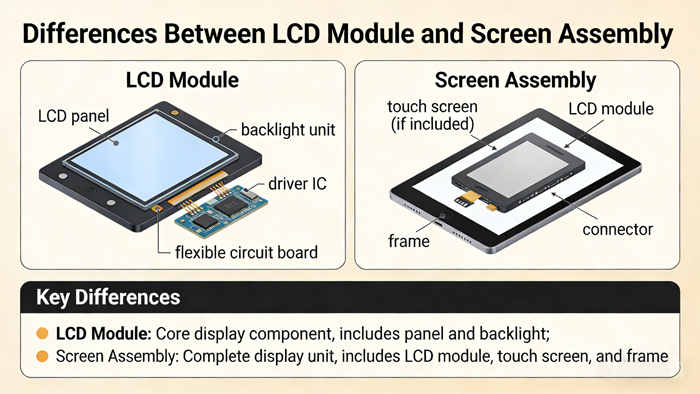
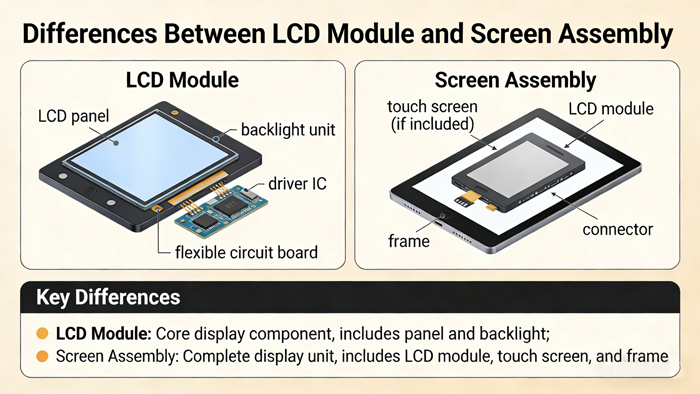
The LCD module is the core display component of the screen, while the screen assembly is a complete component that can be directly installed and used, including the LCD module and other necessary structural components
The LCD module is the core display component of the screen, while the screen assembly is a complete component that can be directly installed and used, including the LCD module and other necessary structural components.
The following are their detailed differences in definition, composition, and practical maintenance applications:
1. Definition and Composition
LCD module
What is it: It is the display core of the screen, professionally referred to as "LCD module" or "OLED module". Its core function is responsible for displaying images.
Composition: Mainly includes LCD panel (or OLED panel), backlight system, driver IC, and connecting cable.
Image metaphor: You can imagine it as the screen panel of a monitor, which itself cannot work independently, needs to be connected to a driver board, and usually needs to be fixed inside the casing.
screen assembly
What is it: It is a complete replacement part for the screen of a mobile phone or device, which can usually be installed and used directly after purchase.
Composition: Screen assembly=LCD module+touch screen (touch layer)+outer glass cover plate+middle frame (or bracket).
Metaphorical image: It is like a complete all-in-one monitor, with its own casing, power button, and interface, which can be used when connected to a computer.
2. Comparison of core differences
Dimension | LCD module | Screen assembly |
Scope included | Only responsible for displaying components. | Display module+touch layer+outer glass cover plate+border. |
Touch function | It does not have touch function itself (unless it is an On cell or In cell integrated technology, but in maintenance terminology, single purchase modules usually do not include external glass). | It includes a complete touch sensing layer and glass cover plate, and the touch function is normal after installation. |
Appearance status | Usually it is just a thin, borderless screen with exposed circuitry at the edges. | Equipped with a front glass panel and borders (if it is a phone, it may have a Home button, earpiece network, etc.). |
Installation difficulty | Professional separation equipment is required, and it is generally not possible to install it directly by hand. | Usually it is a modular replacement part, which can be attached to the wiring after disassembly. |
3. Application differences in actual maintenance
When you need to repair a screen, the choice of these two components usually means different repair plans and costs:
Scenario A: Replace the "LCD module"
Scenario: The repair shop helps you separate the broken outer glass using a professional machine, and then reattach a new piece of glass and touch layer onto your original LCD module.
Advantages: If your original LCD display is good (only the glass is broken), this approach can preserve the original display effect. The cost is relatively low.
Disadvantages: High process requirements, if the repair shop's technical skills are not good, problems such as dust ingress, poor adhesion, and touch failure may occur. Nowadays, this maintenance method is becoming increasingly rare due to high labor costs and greater risks.
Scenario B: Replace the "screen assembly"
Scenario: The most common repair method. The repairman directly removed the entire broken screen, threw it away, and replaced it with a brand new assembly.
Advantages: Convenient and fast, high stability, as the touch and display are perfectly integrated at the factory.
Disadvantage: The price is more expensive than replacing the LCD module separately (referring to the situation where the outer glass is broken) because it includes a glass cover and frame. Moreover, the assemblies on the market may be "rear pressed screens" (i.e. using original LCD modules and rear pressed glass) or "domestically assembled screens", and the display effect may not be as good as the original
summary suggestions
If you see a "LCD module" when purchasing accessories, it usually means that it is a semi-finished product and may require professional installation knowledge, or you may need to remove the touch layer and frame from the old screen and install it on this module.
If you see a 'screen assembly', it is a finished product, and you can simply replace the entire damaged screen when you buy it.
For ordinary users, "screen replacement" usually refers to replacing the "screen assembly".
AUO LCD module:https://www.idtdisplay.com/products/AUO_LCD_Displays/
INNOLXU LCD module:https://www.idtdisplay.com/products/innolux-lcd/