Why is there such a big difference in the viewing angle of LCD screens?

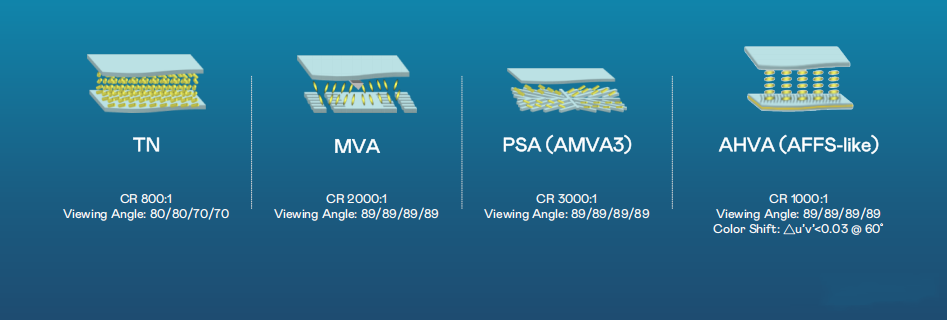
The fundamental reason why there is a huge difference in the viewing angle of LCD screens is the arrangement of liquid crystal molecules and the way they control the passage of light
Why is there such a big difference in the viewing angle of LCD screens?
The fundamental reason why there is a huge difference in the viewing angle of LCD screens is the arrangement of liquid crystal molecules and the way they control the passage of light.
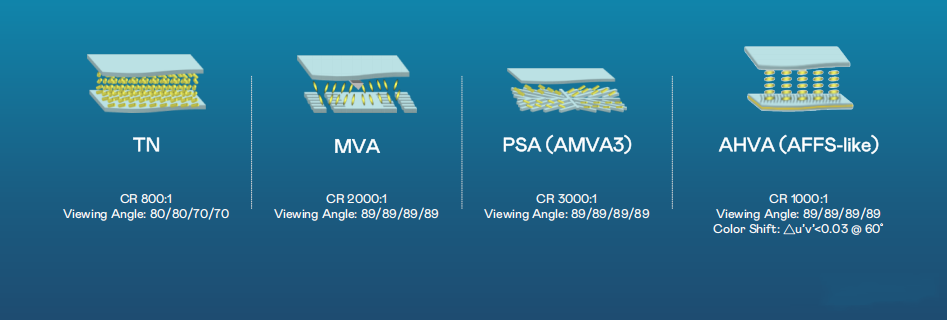
To give you a more intuitive understanding, you can imagine the LCD layer as a "louver", and the backlight is the light behind the window. Different technologies, such as the blade structure and opening and closing methods of blinds, result in varying brightness and color when viewed from different angles.
The following are the fundamental reasons for the differences in viewing angles among the three mainstream panel technologies:
1. TN panel: leaf type louvers, naturally directional
This is the earliest technology and also the narrowest viewing angle.
Principle: In the absence of voltage, the liquid crystal molecules of a TN screen are arranged in a spiral pattern. When a voltage is applied, molecules will rise or fall, thereby controlling the passage of light.
Why is the viewing angle poor: Liquid crystal molecules are like a row of small sticks. When light passes through the gaps of these small sticks, the path of the light is extremely asymmetric.
Horizontal direction (left and right): The light path is relatively symmetrical, and the viewing angle is decent.
Vertical direction (up and down): When you look from top to bottom or from bottom to top, the long axis projection of liquid crystal molecules can block light or cause rapid light leakage and color shift. That's why many old-fashioned TN screens appear white or black when viewed from top to bottom, and even have negative effects (grayscale reversal).
Features: Fast response speed (suitable for esports), low cost, but poor color and narrow viewing angle.
2. IPS panel: signboard style arrangement, naturally wide-angle
IPS was born to solve the TN viewing angle problem, commonly known as "hard screen".
Principle: The liquid crystal molecules of IPS screens are arranged parallel to the glass substrate. When a voltage is applied, molecules do not stand upright, but rotate in a horizontal plane.
Why is the viewing angle good: Because liquid crystal molecules always lie flat, no matter what voltage you apply, the long axis of the molecules always moves in the horizontal plane. For observers, no matter which angle you stand at, the path length of light passing through the liquid crystal layer is almost the same. This is like laying a pair of chopsticks flat on the table, no matter which direction you look at the table, the shape of the chopsticks you see is almost the same.
Result: When viewed from the side, color saturation may slightly decrease, but there will be no significant brightness decay or grayscale reversal.
3. VA panel: vertical louvers, leaning towards the tilt
The viewing angle of VA screen is between TN and IPS, belonging to the "soft screen" category, commonly used in high-end TVs and curved screens.
Principle: In the absence of voltage, the liquid crystal molecules of the VA screen stand perpendicular to the substrate, and light cannot pass through (high black field purity). After applying voltage, the molecules tilt horizontally and light passes through.
Why is the viewing angle moderate: When molecules change from vertical to inclined, the difference in projected area of molecules at different angles is smaller than TN, but larger than IPS.
Advantages: High contrast and deep black areas.
Disadvantage: When viewed from the side, the contrast will rapidly decrease, the image will appear gray (whitish), and the color saturation is not as good as IPS. However, in recent years, through technological improvements such as multi domain VA, which divides pixels into different tilt directions, the viewing angle has been greatly improved.
Another factor that affects the perspective: compensation film
In order to improve the viewing angle of modern LCD screens, in addition to improving the LCD arrangement (such as making TN into multi domains and IPS/VA naturally multi domains), optical compensation films are also attached to the screen surface.
The function of this film is to correct the phase difference of light emitted from different angles, attempting to widen the originally narrow viewing angle of TN. But for TN, this is still treating the symptoms rather than the root cause, just making the screen less prone to negative effects, but the color shift is still significant.
Summary: Why is there such a big difference in the viewing angle of LCD screens?
Panel Type | Liquid crystal molecular state | Light passes through features | Perspective expression | Core reasons |
TN | Stand upright/rotate when switching on/off | Extremely asymmetric path | Narrow (especially poor in top and bottom) | When the molecule stands upright, it blocks light like a stick, and the path changes dramatically when viewed vertically. |
VA | Standing vs tilting | The path is relatively symmetrical | Moderate | The tilt angle of molecules leads to a decrease in side contrast, but there is less color reversal. |
IPS | Always lie flat | Constant path | broad | The molecule always rotates in the horizontal plane, and the viewing path is almost identical in all directions. |
Simply put, the structure of IPS determines its innate wide viewing angle, while the structure of TN determines that without complex compensation, the viewing angle is the worst. This is also why IPS screens are more popular on devices that require multiple people to watch or need to be viewed from the side, such as mobile phones, tablets, and medical equipment.
TFT LCD:https://www.idtdisplay.com/