What are the core technologies and structural characteristics of medical LCD?

Medical LCD screens are designed for clinical diagnosis, surgery, monitoring and other scenarios, featuring medical safety and imaging standards, high-precision display and long-term stable operation, antibacterial, wide temperature range
What are the core technologies and structural characteristics of medical LCD screens?
Medical LCD screen is a professional display module designed for clinical diagnosis, surgery, monitoring and other scenarios. Its core features are strict adherence to medical safety and imaging standards (such as DICOM, IEC 60601), high-precision display and long-term stable operation, as well as the ability to adapt to medical environments with antibacterial, wide temperature range, anti-interference and other characteristics, which directly affect diagnosis and treatment decisions and patient safety. The following provides a detailed explanation of core technologies, key parameters, standard specifications, application scenarios, and selection points:
I. Core technology and structural characteristics
Medical LCD screens are based on TFT-LCD and enhance the following technologies for medical scenarios:
1. Display mode: IPS/ADS full view panel is preferred, with consistent brightness and color at 178 °/178 °/178 °/178 ° viewing angles, suitable for multi person multi view film viewing and surgical observation.
2. Backlight and control light: The mainstream is direct type Mini LED or side entry LED backlight; High end imaging screens support zone controlled lighting and HDR, enhancing grayscale levels and detail contrast.
3. Driver and Calibration: Built in brightness/color temperature sensor, supports automatic DICOM calibration, partially integrated residual image elimination and dynamic Gamma adjustment, ensuring 24/7 brightness and grayscale stability.
4. Protection and interaction: The surface is coated with antibacterial materials (such as silver ions), anti glare/anti reflection treatment, and the front protection level can reach IP65, suitable for alcohol wiping and strong light environments in operating rooms.
5. Electrical safety: Double insulation design, leakage current<100 μ A, in compliance with medical electrical safety standards, to avoid interference with electrocardiogram/monitoring equipment.
II. Key performance parameters (graded by scenario)
The parameters of medical LCD screens need to match different scenarios such as diagnosis, surgery, and monitoring. The core indicators are as follows:
Parameter dimension | Diagnostic grade (CT/MRI/ultrasound) | Surgical grade (endoscope/navigation) | Guardianship level (bedside/central monitoring) |
Resolution | 4K(3840×2160)/8K,≥250 PPI | 4K/2.5K,≥166 PPI | 1080P,≥100 PPI |
Brightness | ≥ 1000 cd/㎡, supports DICOM calibration | ≥ 800 cd/㎡, strong light resistance | ≥ 500 cd/㎡, wide dimming range |
Contrast | ≥ 2000:1, high grayscale (≥ 10 bits) | ≥ 1500:1, HDR support | ≥ 1000:1, clear display of waveform/value |
Color accuracy and color gamut | ΔE≤1.5,99% Adobe RGB,DICOM Part14 | ΔE≤2.0, Wide color gamut, supporting color/grayscale switching | ΔE≤3.0,sRGB, High readability |
Response time | 5–10 ms, No trailing shadows | 3–5 ms, Adapt to dynamic surgical imaging | 10–20 ms, Satisfy static/slow dynamic display |
Operating Temperature | -20℃~70℃ ,Wide temperature range | -30 ℃~80 ℃,Wide temperature range | 0 ℃~50 ℃, partially supports wide temperature range |
Grayscale depth | 12–16 bit, ≥ 1024 grayscale levels | 10–12 bit, High dynamic range | 8–10 bit, Clear display of trend chart |
Grayscale and DICOM: Diagnostic level screens must support DICOM Part 14 standards, with a grayscale linear error of less than 2%, to ensure that lesion details are not lost.
Interface: Commonly used DP/HDMI/eDP/LVDS, the image screen needs to support 12G-SDI/3G-SDI, and some are integrated with USB-C (65W power supply) and multi split screen output.
III. Core Standards and Certification
Medical LCD screens must meet the following mandatory and professional standards, otherwise they cannot be used for clinical diagnosis:
1. Electrical safety: IEC 60601-1/GB 9706.1, covering insulation, leakage current, grounding resistance, etc., to ensure safe use.
2. Electromagnetic compatibility: IEC 60601-1-2, anti-static/surge/radio frequency interference, to avoid affecting the normal operation of medical equipment.
3. Imaging standards: DICOM Part 14 defines the grayscale and brightness standards for medical images, and requires calibration reports and CNAS testing certificates.
4. Quality system: ISO 13485, ensuring traceability of production and quality, in compliance with medical device management requirements.
5. Market access: It is necessary to obtain registration and certification from NMPA (China), FDA (USA), or CE MDR (EU) before it can be applied on the market.
IV. Typical application scenarios
Medical LCD screens are divided into three categories according to their uses, suitable for different clinical processes:
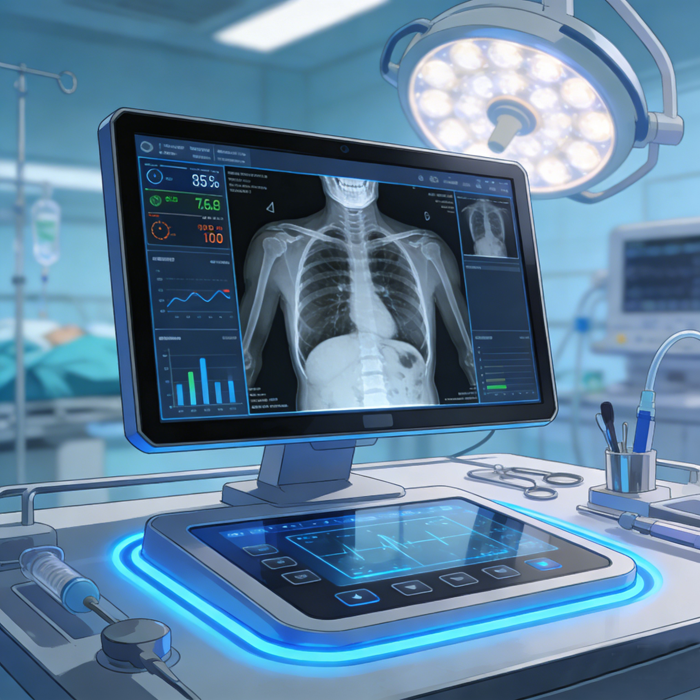
1. Imaging diagnosis category: used for radiology (CT/MRI/DR), ultrasound, pathology, with core requirements of DICOM calibration, high grayscale, and high resolution, such as 27-32 inch 4K diagnostic screens.
2. Surgical navigation category: used for operating rooms (laparoscopic/endoscopic) and interventional treatments, requiring high brightness, low latency, multi split screens, supporting simultaneous display of surgical fields and images, such as 24-27 inch 4K surgical monitors.
3. Monitoring and Bedside Category: Used for ICU/ward bedside monitoring and central monitoring systems, emphasizing wide temperature range, high reliability, and low power consumption, such as 10-15.6 inch portable/embedded modules.
V. Core differences between medical LCD screens and consumer/industrial grade screens
Comparative dimension | Consumer grade LCD screen | ||
Core standards | DICOM+IEC 60601 | Wide temperature range+anti-interference | No mandatory medical standards |
Grayscale/color accuracy | ΔE≤1.5, ≥ 1024 grayscale levels | ΔE≤3.0, ≥ 256 levels of grayscale | ΔE≤5.0, Normal grayscale |
Operating Temperature | -20 ℃~70 ℃ (wide temperature range) | -30℃~80℃(wide temperature range) | 0℃~50℃ |
Reliability | 24/7 operation, lifespan ≥ 50000 hours | 24/7 operation, lifespan ≥ 50000 hours | 8 hours/day, lifespan ≥ 30000 hours |
Protective characteristics | Antibacterial coating+IP65 front | Anti vibration+IP65 | No antibacterial properties, IP20 |
VI. Selection and maintenance points
1. Selection process:
Clear scenario: Diagnostic level must support DICOM, surgical level prioritizes high brightness and low latency, and monitoring level focuses on wide temperature and reliability.
Verify parameters: resolution, brightness, grayscale depth, and interface type must meet corresponding standards, and provide third-party inspection reports.
Confirmation of certification: Check NMPA/FDA/CE MDR and ISO 13485 qualifications to avoid non-medical grade screens being used in diagnostic scenarios.
2. Maintenance suggestions:
Regular calibration: Perform DICOM brightness/grayscale calibration every 3-6 months using original calibration tools or third-party software.
Environmental adaptation: Avoid direct sunlight, control the working temperature between -20 ℃~70 ℃, and regularly clean the antibacterial surface (using 75% alcohol).
Spare parts management: Reserve spare screens for critical equipment to ensure quick replacement in case of failure and reduce downtime.
Summary
Medical LCD screen is the core visualization carrier of medical digitization, and its performance and compliance directly affect the quality of diagnosis and treatment. When selecting, the core should be "standard compliance+scenario adaptation+long-term stability", and priority should be given to selecting professional modules that have passed medical certification and support DICOM calibration, avoiding the use of consumer grade screens as substitutes and reducing misdiagnosis and safety risks.
The selection of medical LCD screens needs to be based on specific scenarios (diagnosis/surgery/monitoring) and size/interface preferences to choose the corresponding medical LCD screen model.
AUO LCD Display:https://www.idtdisplay.com/products/AUO_LCD_Displays