What does the LVDS interface of an industrial screen look like?

The LVDS interface of industrial screens is a flat ribbon connector with a locking mechanism, which has become an important technology in the field of industrial displays due to its high anti-interference ability and reliable physical connection
The LVDS interface on industrial LCD panels is a highly important and commonly used connection. To provide you with a clear and intuitive explanation, I will describe it from aspects such as appearance, structure, and key points.
I. Core Appearance and Structure
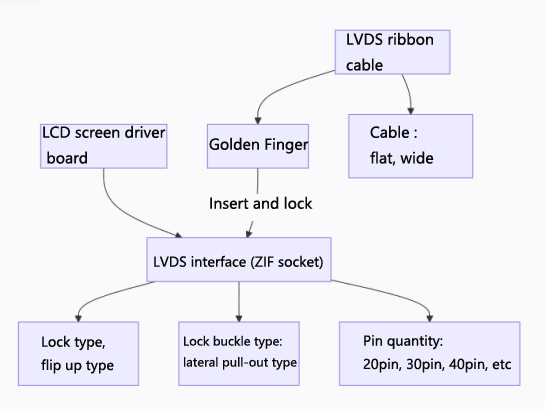
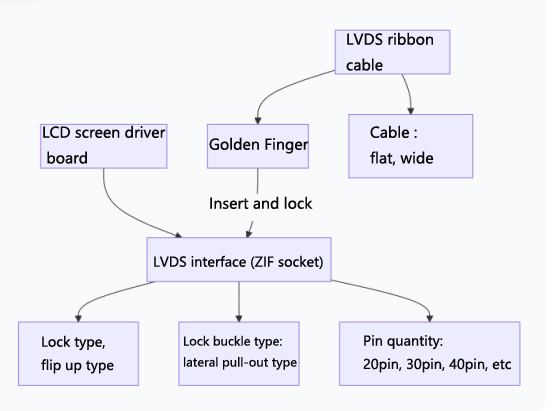
The LVDS interface of an industrial panel typically refers not to a single socket, but to an entire set of connection components, which mainly include:
LVDS ribbon cable
Appearance: A flat, gray flexible cable (ribbon cable).
Width: The width is not fixed, but it is usually wider than other cables on the motherboard because it contains a larger number of wires.
Pin: One or both ends of the cable have golden contact points, called "golden fingers".
LVDS connector (socket)
Location: Located on the backplane circuit of the LCD screen (usually referred to as the "screen driver board").
Type: The vast majority of industrial screens use a socket called "ZIF connector".
Locking mechanism
This is the most iconic feature of the LVDS interface. The ZIF connector comes with a locking mechanism to securely fasten the ribbon cable.
There are two common types of locks:
Upward flip up: There is a small lid that can be opened and closed.
Lateral pull type: There is a small card pin that can slide left and right.
The following figure clearly shows the typical location and physical structure of the LVDS interface on the screen driver board:
II. Several key features of LVDS interface
1. Differential signal transmission
The full name of LVDS is "Low Voltage Differential Signaling". It uses a pair of tightly wound wires to transmit a signal, one transmitting a positive signal and the other transmitting a negative signal.
Advantages: This method has strong anti-interference ability and is very suitable for common electromagnetic interference in industrial environments. It can achieve long-distance and high-speed signal transmission without distortion.
2. Interface color and identification
On the screen drive board, labels such as "LVDS", "JLVDS", or "CNL" are usually printed next to the LVDS socket.
The socket itself is usually white or black.
3. Number of pins
The number of pins is not fixed, common ones include 20pin, 30pin, 40pin, etc.
The number of pins depends on the screen resolution, color depth, and whether touch screen functionality is integrated. The higher the resolution, the more transmission channels and pins are required.
III. Importance in industrial applications
Reliability: Due to its strong anti-interference ability, the LVDS interface can ensure stable display signals in noisy industrial environments.
Standardization: It was once the de facto standard in the industrial display field, and although updated interfaces such as eDP are now becoming popular, LVDS is still used in a large number of existing devices and specific new products.
Easy to lock: The locking design of ZIF connectors ensures that cables will not loosen or fall off in harsh environments such as vibration and impact, which is crucial for industrial equipment.
Important operational precautions
When you need to plug and unplug LVDS cables, please remember:
1. Complete power outage: Before operation, be sure to disconnect the power supply of the equipment.
2. Correctly operate the lock buckle:
For flip type, it is necessary to gently lift the lock buckle cover first, then insert or remove the cable, and finally press the cover to lock.
For the pull-out type, it is necessary to first gently pull out the locking pin upwards, then operate the cable, and finally push in the locking pin downwards.
3. Do not use brute force: Never forcefully pull the cable without loosening the lock buckle, as this may cause the golden fingers to fall off or the socket to be permanently damaged.
4. Anti static: Pay attention to anti-static measures during operation to avoid puncturing sensitive electronic components.
Summary: The LVDS interface of industrial screens is a flat ribbon connector with a locking mechanism, which has become an important and enduring technology in the field of industrial displays due to its high anti-interference ability and reliable physical connection.
TFT LCD:https://www.idtdisplay.com/
AUO LCD Display:https://www.idtdisplay.com/products/AUO_LCD_Displays/