Professional interpretation of four types of display technology in AU LCD

Professional interpretation of four types of display technology in AU LCDThis is the industrial grade LCD display
Professional interpretation of four types of display technology in AUO LCD
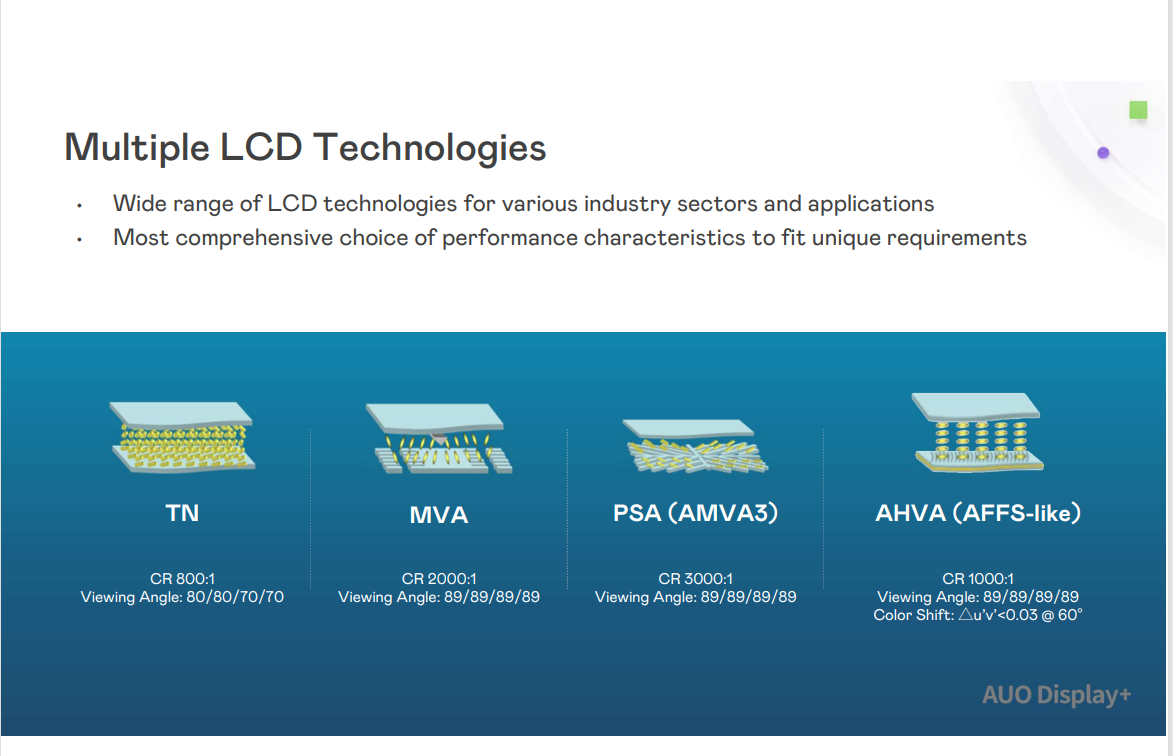
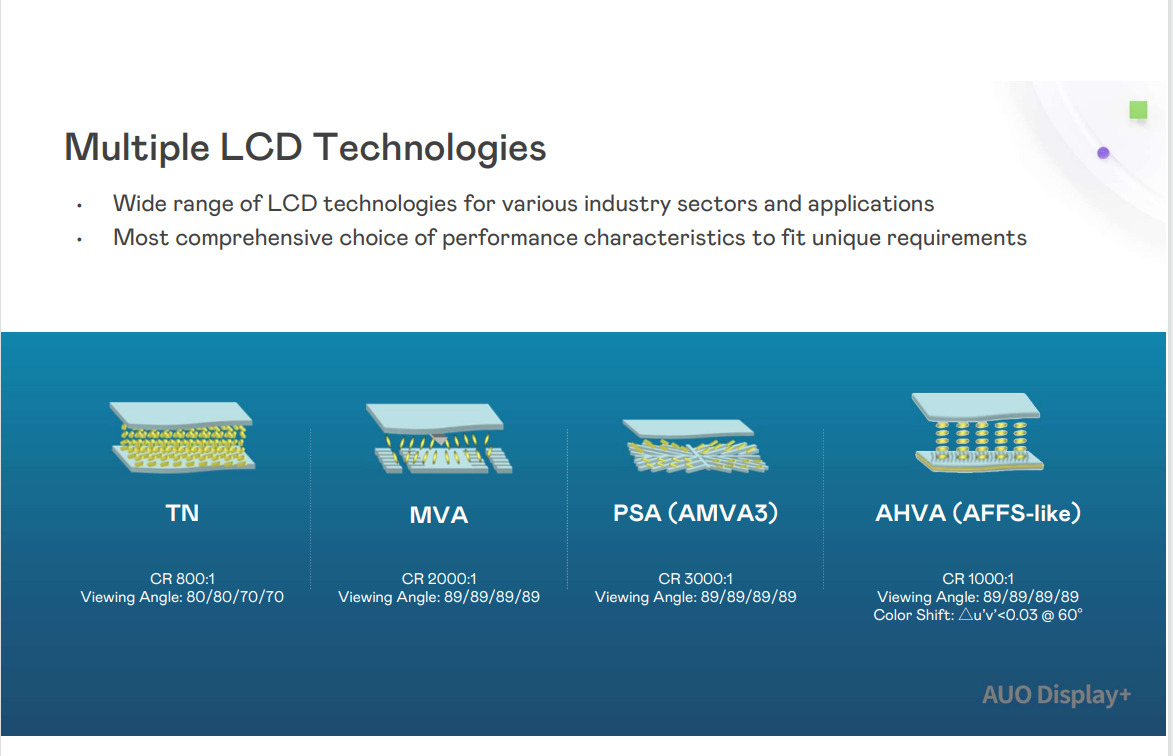
This is the industrial grade LCD display technology roadmap released by AUO Display+, which showcases the structure, core parameters, and applicable scenarios of four mainstream LCD technologies. It is a core reference for selection in industrial control/automotive/professional display fields.
I. Core Explanation
Multiple LCD Technologies has clarified AU's technological layout logic:
LCD technology solutions covering the entire industry and scenario, adapted to meet the needs of different industrial fields
Provide the most comprehensive performance options that can accurately match customers' differentiated technical requirements
II. Four LCD technologies are disassembled line by line (including structure, parameters, and positioning)
1. TN (twisted nematic) technology
Structural characteristics: Liquid crystal molecules are arranged vertically and twist horizontally when powered on;
Core parameters:
Contrast Ratio (CR): 800:1
Viewing angle: 80/80/70/70 ° (up and down/left and right viewing angles, severe distortion in large viewing angles);
Technical positioning: entry-level traditional technology, extremely low cost, only suitable for basic scenes without requirements for viewing angle and image quality;
Current situation: AU has gradually phased out the TN solution and is fully shifting towards high-end technologies such as AHVA;
2. MVA (Multi Quadrant Vertical Alignment) technology
Structural features: By controlling the vertical arrangement of liquid crystal molecules through convex structures, a wide viewing angle can be achieved;
Core parameters:
Contrast Ratio (CR): 2000:1 (2.5 times that of TN, resulting in a purer black field);
Viewing angle: 89/89/89 ° (full view without grayscale inversion);
Technical positioning: Classic wide-angle technology, balancing contrast and viewing angle, is the mainstream solution for traditional industrial control screens;
Current situation: AU has gradually iterated MVA products towards AHVA/PSA technology;
3. PSA (AMVA3, Polymer Stable Vertical Alignment) technology
Structural features: Adding a polymer stabilizing layer on top of MVA to optimize liquid crystal alignment and further enhance contrast;
Core parameters:
Contrast Ratio (CR): 3000:1 (highest among 4 techniques, with ultimate black field performance);
Viewing angle: 89/89/89 ° (full view without distortion);
Technical positioning: High end vertical alignment technology, suitable for professional display scenes with extremely high requirements for contrast and dark field details;
Current situation: One of the core technologies of AU's high-end industrial control/medical display;
4. AHVA (AFFS like, advanced ultra wide viewing angle) technology
Structural features: Similar to AFFS planar electric field technology, liquid crystal molecules are arranged horizontally, which is the core technology currently promoted by AU;
Core parameters:
Contrast Ratio (CR): 1000:1;
Viewing angle: 89/89/89 ° (full view without grayscale inversion);
Color cast control: △ u'v '<0.03 @ 60 ° (60 ° large visual role bias is extremely small, at the top level of the industry);
Technical positioning: AU's new generation full view technology, which combines wide viewing angle, low color cast, and high response speed, perfectly adapts to harsh scenarios such as industrial control, vehicle mounted, and outdoor environments;
Current situation: AU's main technology for full-size industrial control screens, fully replacing the old TN/MVA solutions;
III. Horizontal comparison table of key parameters
Technical Type | Contrast | Viewing angle | Core strengths | Core Shortcomings | Applicable scenarios |
TN | 800:1 | 80/80/70/70 | Extremely low cost, fast response | Narrow viewing angle and large color deviation | Basic instruments, low-cost equipment |
MVA | 2000:1 | 89/89/89/89 | High contrast, full view angle | The response speed is average | Traditional industrial control and commercial display |
PSA(AMVA3) | 3000:1 | 89/89/89/89 | Ultimate contrast, pure black field | Relatively high cost | Medical imaging, professional monitoring |
AHVA | 1000:1 | 89/89/89/89 | Ultra low color cast, full view angle, fast response | The contrast is slightly lower than PSA | Vehicle mounted, outdoor, high-end industrial control |
IV. Core logic of technology selection (providing customers with selection suggestions)
1. Pursuing ultimate cost-effectiveness and basic display: choose TN (but AU has gradually withdrawn from the market and is not recommended for new projects);
2. Traditional industrial control scenarios, balancing cost and perspective: choose MVA (stock replacement solution);
3. Medical/monitoring, with extremely high requirements for dark field details: choose PSA (AMVA3);
4. In car/outdoor/high-end industrial control, require full view angle and low color cast: choose AHVA (currently promoted by AU, future mainstream);
V. Supplementary explanation of professional terminology
CR (Contrast Ratio): The ratio of the brightest to the darkest brightness on the screen. The higher the value, the purer the black field and the stronger the layering of the image;
Viewing angle: The maximum angle at which the screen is viewed from the top, bottom, left, and right directions without distortion, with 89 ° representing full view without grayscale inversion;
△ u'v '(color cast): a core indicator for measuring color distortion under a large viewing angle. The smaller the value, the smaller the color cast. AHVA<0.03 is the top level in the industry;
AFFS like: class advanced edge field switching technology, which is the core underlying layer of AU AHVA technology, realizing planar electric field driving, greatly improving viewing angle and color cast performance;
AUO LCD:https://www.idtdisplay.com/products/AUO_LCD_Displays/