What is liquid crystal glass?

Liquid crystal glass, also known as LCD cell or LCD cell, is the most core and precise part of LCD display screens, and it is where images are generated You can understand it as the "retina " of a monitor
Liquid crystal glass, also known as LCD cell or LCD cell, is the most core and precise part of LCD display screens, and it is where images are generated. You can understand it as the "retina" of a monitor.
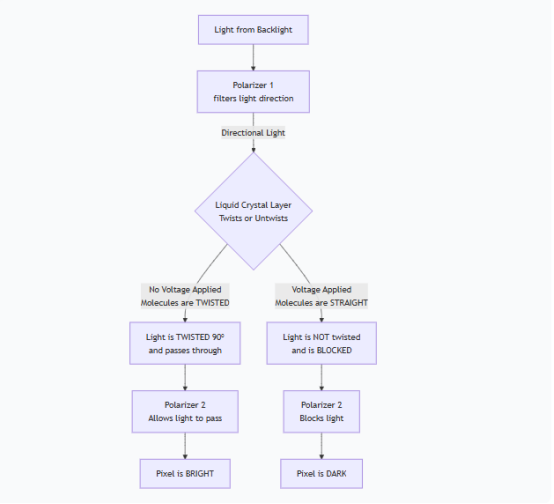
To gain a more intuitive understanding of its core structure, you can first refer to the following diagram, which illustrates the basic layered composition of liquid crystal glass:
Detailed working principle of LCD glass
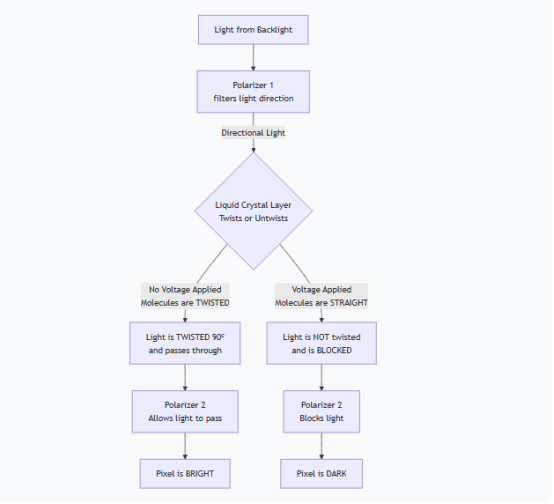
As shown in the above figure, LCD glass is like a "light valve", and its basic working principle is as follows:
1. Infrastructure: It is mainly composed of two very thin glass substrates bonded together, with liquid crystal material filled in the middle.
Bottom glass substrate (TFT Array): Millions or even billions of thin film transistors (TFTs) have been fabricated through photolithography, with each transistor corresponding to a sub-pixel (red, green, blue) on the screen. These transistors are like independent switches.
Color Filter: The inner side is equipped with a color filter, and each pixel position is divided into three sub units: red (R), green (G), and blue (B).
Polarizer: On the outer side of two glass substrates, there will be one polarizer attached, and their polarization directions are perpendicular to each other (usually 90 °).
2. Working process of "valve":
When the light from the backlight passes through the first polarizer, it will become light in a specific direction.
Light enters the liquid crystal layer. Without electricity, the arrangement of liquid crystal molecules will be twisted by 90 degrees, thereby reversing the direction of light by 90 degrees, allowing it to pass smoothly through the second polarizer, and this pixel will appear "bright".
When a voltage is applied to the thin film transistor, the liquid crystal molecules will stand up under the action of an electric field and no longer twist the light. At this point, the light cannot pass through the second polarizer, and this pixel appears "dark".
By precisely controlling the voltage on each sub-pixel transistor, the deflection angle of liquid crystal molecules can be precisely controlled, thereby controlling the amount of light transmission and ultimately forming rich gray levels from black to white.
3. Display color images:
By controlling the transmittance of each R, G, and B sub-pixel, the human eye will mix these colors from a distance, resulting in a rich and colorful full-color image.
LCD Glass vs. LCD Module
This is a key difference that can help you better understand the industry chain:
LCD glass is the core material, it cannot emit light on its own, nor can it work independently. It only achieves control over the light.
LCD module is a functional component that integrates backlight, driver circuit, iron frame, etc. on the basis of LCD glass, making it a complete functional unit that can light up and display images.
Simple metaphor:
LCD glass is like the slides of a projector - it does not emit light itself, but determines the shape and content of the image.
Backlight is like the light source of a slide projector - providing a source of light.
The LCD module is a complete slide projector - including a light source, slides, and necessary structures.
Main types and technologies
Liquid crystal glass itself can be divided into several main technical types based on the different arrangements of liquid crystal molecules and electric field modes used:
TN: Low cost, fast response, but small viewing angle and poor color.
VA: High contrast and good color, commonly used in television technology, but slightly slower response speed.
IPS: With the widest viewing angle and accurate color, it is the preferred technology for high-end displays, phones, and tablets, but with relatively high power consumption.
summary
In summary, liquid crystal glass is an extremely precise electro-optical conversion device that controls the arrangement of liquid crystal molecules through voltage, precisely controlling the passage of light through each pixel like a valve, thus creating every image we see on the screen. It is the technological and value core of the entire LCD display industry.